TUNE IN
Podcast

Non-Billable Hours
The Official Mosaic Search Partners Podcast
Non-Billable Hours is Mosaic Search Partners' podcast about the people who work in law. We talk about their careers and what they've experienced inside the industry, with room for the candid conversations that rarely make it into a firm announcement.
APPEARED AS A GUEST ON
Guest appearances

Legal Chutney with Jagdeep Sekhon
Lateral Moves, Hiring Rules
Bryson joins Jagdeep Sekhon to talk through a lateral move: how to read demand in your practice area, prepare a useful resume, and decide whether a firm fits. They discuss firm culture, DEI, and the business considerations that shape hiring. They also get into building professional relationships and finding work you enjoy.
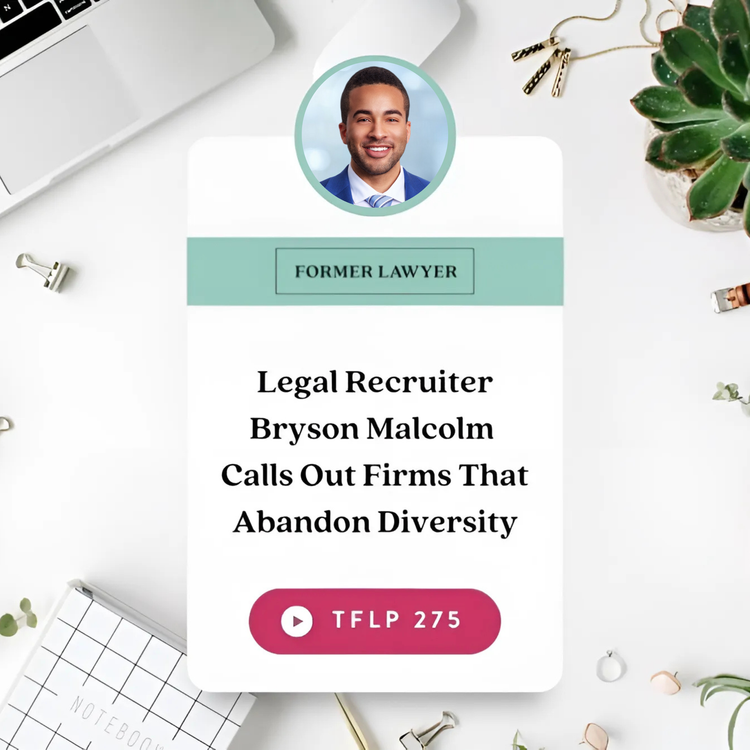
The Former Lawyer Podcast with Sarah Cottrell
Episode TFLP 275
Bryson joins Sarah Cottrell to discuss law firms that have scaled back their DEI commitments, what that means for attorneys from underrepresented backgrounds, and what to ask when considering an employer. He shares what he hears as a recruiter in candid conversations about firm culture.
PREFER TO READ
Episode Transcripts & Show Notes
Full transcripts and detailed show notes for those who prefer reading or want to reference specific quotes. Click any episode below to expand. New to the vocabulary? The glossary and field guides cover every term and timeline that comes up in these conversations.
Transcripts are auto-generated from episode audio and may contain minor errors. Listen to the original episode for verbatim accuracy.
Episode 4: The #1 Thing Big Law Partners Regret Not Doing Sooner (w/ Eva Wisnik)
Guest
Eva Wisnik, Founder of Wisnik Career Enterprises; career strategist and executive recruiter with over three decades shaping how top law firms hire, train, and retain their people; previously ran recruitment and training at Schulte Roth & Zabel and Cadwalader, Wickersham & Taft; has worked with more than 120 law firms, placed over 1,000 recruitment and marketing professionals, and delivered more than 800 training programs nationwide; Psychology degree from Barnard College (Columbia) and an MBA in marketing from Fordham. Her insights have been featured in The New York Times, The Wall Street Journal, and Bloomberg.
Show Notes
This is a conversation about the common pitfalls in and best practices for building a network as a law student or attorney, seen through the lens of feedback from the nation's top rainmaking partners and business development professionals.
Bryson considers Eva Wisnik one of his close mentors, someone he respects deeply and thinks extraordinarily highly of. This is one slice of the wisdom Eva has spent decades discovering and refining, and it belongs in the go-to toolkit of any law student looking to set themselves up for success in both the immediate and long term.
The number one regret Eva hears from successful partners: they let the relationships from early in their careers go quiet. She and Bryson dig into why that costs people on both the business side and the fulfillment side, then get practical. Listening beats charisma. Bringing two people together makes you a "networking gem." One small touchpoint a day compounds. And ghosting people, in Eva's book, is the true opposite of networking.
Listen on Apple Podcasts › Listen on Spotify ›
Full Transcript
Presented as a continuous conversation between Bryson Malcolm and Eva Wisnik.
The #1 Regret of Big Law Partners
What was the number one regret or thing that partners mentioned, as it had to do with networking, that you think would be useful for people to know early on?
So in the three-plus decades I've been working with attorneys, originally as a head of recruiting for two law firms in New York City, and now as a consultant to over 120 law firms, it's just fascinating when I'm teaching associates how to manage their careers, how to create new opportunities at different stages. What I hear when I go back to the partners who were clearly successful enough to make partner, they say, "I wish I had maintained my relationships with the people I went to law school with, the people I knew early on in my career."
That is a really big regret. And my theory on that is probably two sides of it. One is just raw business development, which for those who don't understand the economics of Big Law, which is unfortunately a lot of people, I think that's part of the model, keeping people a little bit in the dark. Business development and origination is a huge chunk of where partners make their money. And I would imagine it's easier to build that connection with a decade plus of relationship building versus knocking on someone's door at JP Morgan and asking for work. And then on the other side, I'm sure it has something to do with isolation and more of the human element of wishing they had stayed in touch. But which side do you think it leans towards more, or is it a combo?
I think it's a great question. In the context of the training, this was specifically for a program I do for mid-level and senior associates on your next level of success, how do you create that?
Why Relationships Drive Fulfillment
That's where I was getting this direct feedback from multiple partners. I do think it's definitely connected to business development, but as somebody who's been studying lawyers' careers for 30-plus years, I would say it definitely impacts fulfillment. So to me, a successful career is not just one where you get to make partner or even become a GC, but one where you have deep connections, because you actually feel safer.
One thing I've observed in all the years I've worked with big law firms is that firms disappear. I started out at Schulte Roth & Zabel when I was 25 years old in 1989, which sounds like a long time ago. The firm was very successful, very niche. Paul Roth started the first hedge fund. Very entrepreneurial, and as of last year, they disappeared into McDermott. Then I went to Cadwalader, the oldest law firm in New York City. I was there as the head of recruiting for a few years before I started this business, and July 1st they're gonna disappear into Hogan. You can't stop change and you can't stop consolidation, but if you have great trusted relationships, you will always have opportunities.
I think that's gonna be even more relevant in the future. As you said, the speed of firms dissolving is really rapid. I remember when I was a summer, partners were telling me stories about Dewey & LeBoeuf like it was crazy ancient history that would never happen again. And since then we've had Stroock & Stroock dissolve. Most of what we're seeing now is more the mergers, which are called mergers on paper but are really acquisitions, and little firms get eaten by bigger firms.
That's right. So if I were talking directly to a law student right now: yes, you need to acquire skills, you need to become the best attorney, you need to acquire knowledge, but you have to maintain your relationships. And what that looks like is picking out the people you sincerely like. I don't think it ever works if it's not authentic. But instead of saying, "Oh, I'm so busy, I'm starting a career," just putting it into your schedule, quarterly, whether it's right before certain holidays. It could be 4th of July, then Thanksgiving, then spring. And just thinking, "Who do I know that I would just love to stay in touch with?" That could be a text: "Thinking of you. How's your new job going? Congratulations, I read about your marriage," or that you're moving. "Is there anything I could be helpful with?" But doing that way before you need it.
If we plant the seeds and water them and take care of them, they're just gonna be there for us. But you can't go backwards. You could try, but if other people have stayed in touch with that classmate of yours and you haven't, and seven years later they're assistant GC or they launch a company, it's gonna feel cringey then.
You might think it's cringey now. It's not cringey to be in touch. It's cringey when you call when you need something, or all of a sudden they've made it. I think the earlier you start investing in those relationships, the less transactional it feels, which is why it's important to start when you're a student or a junior.
A lot of people have the complaint that it feels transactional, or that networking is a weird amorphous word that feels business-y adjacent, and lawyers kind of have a knee-jerk reaction to being compared to business people. But it doesn't have to be weird. It's just hanging out with your friends in law school, meeting more people, remembering to stay in touch with folks throughout the years. Going to bar review counts as networking. If you show up and have conversations, it does.
Make It About Helping Others
So let's make this practical and realistic. What I love, and I think will resonate with people, is make it about helping other people. Early on in my career, when I was trying to build a business and a network and I would go to places, instead of thinking, "Oh my gosh, is there gonna be somebody in the room who can hire me to do training or needs a marketing person?" I would go in saying, "Let me listen and see if there's anybody in the room where I could be the slightest bit helpful."
And helpful does not always mean business. It could be that their child is applying to colleges and you love the school you went to and you're on the alumni committee. It could be that you travel a lot and somebody else is going to Italy and you have this great list of restaurants. Or you're an avid reader, or you love music. If you're listening, people say things where you think, "Wait, I could be helpful. Let me send you that link. Let me send you that list." And people as humans cannot help but reciprocate. Most people. Not all people. Enough people.
So if you put out the things that could be helpful to them, that are natural for you, it just comes back. Maybe somebody needs an apartment and you're moving with your significant other, and you say, "This is a great building. Why don't you take over our lease? Join us in a Hamptons share." Every day there are things that we need from other people. And if you're listening, or you just ask, "Is there anything going on in your life that I could be helpful with? Any resources, books, anything?" People say, "Oh, actually, I was looking for..." And then you say, "I don't know that, but let me reach out to somebody who is really familiar with that." That's another very powerful tool in networking.
Become a Networking Gem
The best networkers I've ever seen, and there were a few partners who were major rainmakers and actually looked like they were having fun doing it, they brought people together. So when you're gonna go to lunch or breakfast with a classmate from college or law school or a past internship, think, "Is there somebody else that should join us?" Or when you're talking to somebody, say, "Oh my gosh, you need to meet my friend." You bring them together and you go too. It could be a quick drink or a cup of coffee. But the people who become catalysts for relationships and opportunities, I call them networking gems. And I think we all have that ability.
The other thing I wanna address and really dissolve this myth: you do not have to be an extrovert to be a great networker. You know what the most important thing is to be a good networker, Bryson? Listening. And the truth is that being an introvert, which most attorneys are, means they're probably better at listening than just talking. So if you listen, you're gonna hear stuff, and sometimes it doesn't happen in the moment, but then you have a conversation with somebody waiting in line, or you're at a wedding, and you go, "Wow, that person mentioned this. Let me follow up and send this." It's listening and following up that makes the best networkers, not how many people you meet in a room.
I think remembering little details about people is really key. That's how I've been pretty successful with networking since I was really young. And I would advise people, though this can feel kind of weird and I only started doing it recently, taking notes on people in your life, whether it's friends or professional contacts. It did feel kinda cringey in the beginning, but then I remembered that people really do appreciate it when you remember things about them. At the end of the day, I don't think they care how you go about remembering it.
And when you look at that note, one, the act of taking it helps you remember it more. You might not even need to reference it. And two, if you go back and look, say you're unable to connect with somebody from law school for three or four years, but you come back and remember that their sister was in medical school, and you say, "How's your sister doing? Did she get matched somewhere?" I guarantee that person is not gonna be thinking, "Does that person have notes on me somewhere?" It's just facilitating more relationship building and keeping everything consistent.
And here's the thing. I don't care how much AI we have, how much technology in the world, people wanna be seen. And if you listen to them and remember something, you could have it right in your Outlook under notes. We do that with our candidates. I would say one of my greatest natural talents is that I have a really good memory. It happened today. I was on the phone with a chief HR person from a law firm where we placed a CMO, and we have a couple other candidates there, and I needed to tell her something confidentially about one of the candidates, which she took very well. And then she mentioned she's having surgery next week. I said, "I'll be thinking about you. Is your daughter back from dental school? Will she be at home?" She's like, "I can't believe you remembered my daughter went to dental school last year." And you could hear it. So if you can remember that and drop a note. I also find, and it has to come from a place of sincerity, that if anybody is going through a rough time, if you hear somebody lost someone, if you take a moment to acknowledge that and check in, that's where the bonds come from. That's where the humanness comes from too.
We have all that happening all the time. I think we overthink it. And then we don't do anything. And then the opportunity is kind of lost on us. And it could be micro actions. It doesn't have to be big things. The biggest thing is attending a conference or a meeting in person, but before you do, it's so important to identify your intention. This morning I had breakfast with somebody I placed originally 20 years ago. She's now the head of all lateral partner hiring at a major firm, and she happens to live right where I get off the ferry when I come in from New Jersey. I said, "Come meet me for coffee." And as I was walking from the ferry to meet her, about an eight-minute walk, I was recalling all the years I've known her, thinking, what do I wanna ask her in this conversation? So I come in with some intention. It's still very flowy and sincere. Intentionality is not a bad thing. It's not weird. Everybody's time is valuable.
I agree. I also wanted to mention that there's been a lot of research I've been looking into about happiness and fulfillment in career and in life, and it seems like the number one thing that's sustainable, outside of wealth creation, is doing things for other people and feeling like you're useful to other people. So this networking thing can be viewed in that angle, where you're helping other people, which is great, but you will feel better if you feel like you're helping lift other people up with you. And it's just a way better experience for everyone.
That's where the fulfillment comes from. I remember Steven Schulte was a real mentor of mine, one of the founding partners of Schulte Roth & Zabel, an amazing guy who became a professor later in his career, first at Cardozo and then out at Stanford. And he once said to me, "If you make your clients your friends, you're gonna have a really long and prosperous career." Having had the career I've had, so many of my closest friends are clients. I don't just call them up when I need business, but it's this synergistic relationship where of course they're gonna be thinking about me, but it's not just about the business transaction. I would do anything for them, and they know that. If they called me up and said, "My kid has an interview, can you prep them?" or "Can you come in? I need a favor," I'd say, "What can I do?" It comes from a place where it's not a burden. It's not a responsibility. You just wanna help people. And that's where the fulfillment comes in. It's profitable, but it's also incredibly fulfilling.
The symbiosis is really important, and that's something I see with my work all the time that I do not take for granted, and I think it is replicable inside Big Law if you do it correctly. It takes extra energy. And it's better to get these habits cemented early on. So let's talk about it, because many of our listeners are working in Big Law or about to head into Big Law if they're law students. I think the other part of networking, or a connective thing to networking, is mentoring.
How to Be a Good Mentee
I don't know any new or younger professional, even mid-career professional, who doesn't want mentors or sponsors. But I think most of us are really bad at being mentees. I just did a dozen summer associate training programs around the country, and I asked, "Are you willing to be a good mentee?" And what that looks like is that when somebody offers you advice or takes you under their wing, brings you to a meeting, you need to say, "Thank you, and here's how this has impacted me." Or if you sit with a mentor, formal or informal, and they give you advice about which firm to choose or how to handle something, you need to take the time to circle back to them.
If anybody's listening: who wrote your letter of recommendation for law school? Do they know where you ended up? Who helped you? Who was your reference? Do they know what law firm you're at? And if they don't, it's okay. But you gotta circle back with them. Don't say, "Oh, it's too late." Just say, "Thank you so much. Here's where I ended up." If you keep taking care of those mentors, they're gonna be there for you forever.
So those are the relationships with people who are more senior, and then you want relationships with your peers. And you gotta change your mindset around that, because most of school you're competing with your peers, and now you have to be collaborating with them. If you make somebody else look good, if you help them out, I have a feeling it's gonna pay in spades. It's no longer one valedictorian or one person who can get that great job. You can both be very successful. One of you can go in-house, and one can stay in a firm or start a business. And I know all of it could be overwhelming, and we all tend to be overthinkers, because law school sets us into that mode.
One Action a Day
One action a day. It could be one quick text, one email, forwarding somebody an article, "This made me think of you." I will do this. I'll be in Madrid, and I walk down the street and see a building with one of my law firm client's names on it, and I'll take a picture and say, "Thinking about you." I've done that in Santa Monica. It's just thinking, how are you? And people are like, "Oh my gosh, I can't believe you're in Madrid or Santa Monica." But it's more just, "I'm thinking of you. I don't need anything. I'm not asking for anything. I just wanna check in."
One action a day. It's not hard. There's a lot of things that people do naturally that they don't give themselves credit for, that are networking. A lot of students I talk to beat themselves up and say, "I'm not good at networking. I don't know how to do it," or "I can't be consistent." But then if you actually look at their life and what they're doing, they are doing it. They're just not giving themselves credit. So on top of adding a little bit more to your to-do list, also go back and be conscious of what you're doing every day anyway, because a lot of it will qualify. And it feels good to feel like you're making progress in a natural way. Building relationships is what we're talking about.
The Opposite of Networking: Ghosting
The only other thing I would say, not to leave on a negative note, is that there's the opposite of networking, which is ghosting. Even if it's uncomfortable to let somebody know you're not accepting their offer, everybody's got databases now. When I was the head of recruiting at firms, if somebody didn't respond, we'd put in their file "never respond to their offer." And if they came back three years later as a lateral, we'd think, "Would we wanna put somebody in front of our clients who never responded to something?" So even if it feels uncomfortable, just do it. And even if it feels uncomfortable to reach out and they don't respond, it doesn't mean they didn't get your email or text. Next time they see it, they may say, "I was gonna write back a long message, and next thing I knew, but thank you so much for reaching out."
You don't need that many people in your network to have an incredible career. And to even have great clients. You ask most rainmakers, they don't have 100 clients. So if you want options, if you went to law school because you want options and opportunities, yes, you wanna study and be good at your craft, but you have to have the relationships, because they're the fuel of careers. If nobody knows who you are or what you do, you're gonna be more limited than you think. You won't have as many options as you hoped.
And I also think, from what I've seen statistically, if you have someone in law school who performed at median or maybe even below, but they were out there building relationships and people think they're a genuine person, that person's gonna go further ultimately than the person who was cutthroat at the top of the class. And even in the off chance that the cutthroat person has some official achievement that looks impressive, I guarantee it's not gonna be a fulfilling experience for the person who just clawed their way up and didn't give anything back. So it's more important than people realize. It's not just a fringe thing you can throw in or leave out. It's integral to your career in the same way that getting good grades are, or going to the right firm is.
Episode 3: Psychologically Preparing for Big Law (w/ Sarah Cottrell)
Guest
Sarah Cottrell, Founder of Former Lawyer; host of The Former Lawyer Podcast; graduate of The University of Chicago Law School; three years in Big Law; transitioned to a judiciary role
Show Notes
Big Law doesn't break folks down because the substantive work is "too hard." If you made it all the way to the AmLaw 100, odds are you can handle the intellectual rigor. Big Law breaks attorneys down by being psychologically unsafe, and most high-achievers have no framework for guarding against that when they walk in.
Bryson Malcolm talks with Sarah Cottrell, founder of Former Lawyer and host of The Former Lawyer Podcast. Sarah graduated from The University of Chicago Law School and spent three years in Big Law before transitioning to a judiciary role, and she has spent the last several years interviewing and working with many lawyers who left Big Law as well.
The conversation covers why firms are good at marketing mental health and often bad at supporting it, how toxic partners run teams in ways that train associates to assume they are the problem, and what is happening economically that lets some problematic rainmakers keep their power no matter what they do.
The discussion also moves into what happens when someone reports misconduct, why calling a labor and employment attorney before HR is often the better move, how bias shifts the math for women and lawyers of color, and why burnout is baked into the pyramid model and is not a reflection of personal weakness.
The back half of the episode is about preparation. Sarah and Bryson talk through what a real support system looks like before you start: a therapist who understands trauma, a short list of non-negotiables written down somewhere you will actually look at, a network of former Big Law attorneys who can reality-check you, and friendships outside the lawyer bubble that keep you grounded when the firm starts feeling like your whole world.
Worth a listen if you are starting at a firm soon or trying to figure out whether what you have been feeling is you or the Big Law environment itself.
Listen on Apple Podcasts › Listen on Spotify ›
Full Transcript
The thing about Big Law is that it's not about the work being hard. It's about the environment being psychologically unsafe in some very fundamental ways. I think it's particularly difficult for people who became lawyers because so many of us have been on the path all the way through like LSAT law school, take the bar, start it a firm, and we're very used to like hitting the marks that tell us that we have achieved and those things make us feel good about ourselves.
And I'm not saying like bad to want to achieve. But I think the challenge with Big Law in particular is that even if you're doing an amazing job, you often feel like you have no idea what you're doing and no one is going to really tell you. I am Sarah Cottrell.
I am the founder of former lawyer, I host the former lawyer podcast. I was that liberal arts major who wasn't exactly sure what she wanted to do after she graduated from college. And it's like, I look like research and writing.
I like constitutional law, which is grim in 2026. Anyway, and so I went to law school and that's how I became a lawyer. And then I was in Big Law for about three years.
I pretty much knew within the first year, Absolutely not. This is a hell hole. Get me out and I left and worked at a legal publishing company for a year And then I went to a state court of appeals and I worked like as a chambers lawyer for six years and after practicing law for 10 years I paid off my law school loans and I left law and Originally I planned to do some like freelance writing, but I also wanted to start this podcast because when I Started thinking about doing something else.
I feel like you always hear like you can do anything with a law degree and then and you're like, but no, but what can I actually do? And so I started the podcast in August of 2019, which means it will be seven years old in a couple months, which is wild. And I interview lawyers who have left law to do other things.
And I also now work with lawyers who realize, I don't wanna be a lawyer, but I don't know what I did that I want to because a lot of us never really developed those. This skills that help people make a good career transition. So that is what I do.
And that is what I do. And I also talk a lot about mental health because when I worked in Big Law, I had a clinical anxiety disorder, which I did not know. And I found out after I left and that helped explain a lot of things, but also notoriously Big Law is very not a great environment for mental health.
And there are a lot of different reasons for that. I know we're gonna talk about some of those. And so I talk about that a lot in my work as well.
One of the things that I realized when I started in Big Law was that maybe this was different for the generation that I started, but the firms are doing a pretty good job of talking about mental health in a good way. Like they knew the right things to say in the beginning. So they created this illusion that I thought they were more on top of it.
And I think, especially because the pipeline to those firms is usually very liberal institutions that seem like they're more on top of mental health generally speaking. I think I was expecting something a little bit different than what was actually available once I got in. So I think that's a trick too that kind of messes with people who might buy the initial pitch of a firm.
I think I would like to think, most people are smarter now, given everything that's happened in the industry, but just in case it's not clear, they're good at marketing in some sense or making you feel like the resources are there, but then it's like how many people even try to use them in the first place? And it is self-selecting where I think a lot of successful law students and successful attorneys usually tend to try to handle everything on their own. Don't want to talk about their feelings, just keep doing more work to fix the problem, more try to get more validation from like very cold sources.
There are patterns, but actually, I had a question. Did you start in Big Law as a, did you do a summer associate position or did you start? Was the first entry point?
Has it a search? So I did summer. All right.
So I graduated in law school in 2008 first, just like for everyone's context. So like, I graduated and then that fall is like when Bear Stearns and Lehman brothers and all that stuff happened and etc, etc. But I had summer at Sibley in Chicago and I got an offer, But I met someone in law school and we were getting married and we were moving to Houston at the time.
I simply didn't have a Houston office because this was low those many years ago. And so I had to go get another job at another Big Law firm because I couldn't accept the offer because we were moving to Houston. And that summer class at Sibley by the way in 2007 was a hundred people, which just like, I don't know what it is now.
Wow. It, after 2008, it was a precipitous drop off in terms of the size of the summer class. Jeez.
I remember I was seeing like Simpson Thacher summer class size last year was like 220 or something like that. Wild. It's insane.
And then my summer class at Skadden was like 105. And my, so that was 100 people just in that office. So just the Chicago office of Siddly, not all their offices.
That's right. That's right. So what I'm saying is there are things about my experiences of summer that I think are very different from the experience of someone who's summery now because that things never have rebounded to that level.
Yeah, probably for the best honestly. Yes, yes, but yes, yes, I guess I wanted to start off with the general question of why it is that super high achieving law students and like high achieving associates attorneys, whatever tend to be psychologically underprepared for Big Law when they step in. And I think a lot of students, especially those that have gone straight through or maybe worked in academia or something.
That's a little less like intense corporate before law school. You can often think that college is really hard. Maybe you went to an Ivy.
Maybe law school is really difficult. You went to you Chicago tends to be pretty difficult as in terms of T sixes. And but I think it's a very different kind of difficult and it doesn't really translate.
But yeah, if you have any thoughts on why it is that once they step in the door of big lot, why it takes them off guard. literally so many thoughts. So just cut me off when you're like, you know what?
So I think first, the first thing is that is just to amplify a point that you made. Like, I think a lot of law students, when they hear Big Law tough, they think, oh, it's a lot of work or it's a lot of hours, or like even maybe people are really demanding, but then they're like, what, I work really hard. I've done all these things.
And so there's a sense of, and I think in the past, for many of us, who went to law school, it was accurate to assess some other thing and say, I work really hard, that will translate here. The thing about Big Law is that it's not about the work being hard, it's about the environment being psychologically unsafe in some very fundamental ways. I think it's particularly difficult for people who became lawyers because so many of us have been on the path all the way through like LSAT law school, take the bar, start it a firm, and we're very used to like hitting the marks that tell us that we have achieved and those things make us feel good about ourselves and I'm not saying it's like bad to want to achieve but I think the challenge with Big Law in particular is that even if you're doing an amazing job, you often feel like you have no idea what you're doing and no one is going to really tell you.
Like you are just not going to get a lot of feedback. That's like you're doing a good job. You also are often going to get feedback that's negative, but it's like very contradictory.
So for example, you might get like, why did you do this memo this way? The way this firm does these kinds of memos is blank and then you can memo for someone else. And it's like, why did you do the memo?
Do you know what I mean? And part of that I think is the function of law firms in general where you have a bunch of different partners and senior associates who all have their own preferences and often think of them as like the way things are done, but actually you're just having to like work to someone's preferences and then also another big piece of it I think in terms of people's mental health is that the law attracts nerve. And so if you go to a Big Law firm, there's going to be some number of people there who are narcissists I know that's a huge buzzword that has lost all meaning but a narcissism is a real thing and when you work for a narcissist or work in a narcissistic system You're going to feel Gaslit so for example, they're going to say we really care about your mental health.
We don't want you to do things that are bad for yourself But here is 72 hours of work to do in 48 hours How do we square these things? Often what lawyers do is they're like, there must be something wrong with me, but I can't both do this and also be supportive of my mental health because they're saying they support my mental health and want me to have good mental health. So I must be the problem.
I think lawyers in general tend to be people who are inclined to think that they are the problem. Yeah. I think also I agree with everything you said.
I think there's also this inherent trust for a system because I think lawyers inherently trust a system more than other professions because it's like our whole profession is understanding how the system works and it's set up in the constitution in low blood. Whether or not you think a lot of that is bullshit or certain laws should be different, etc. I still think there is more of an inherent trust in that system probably because what you're describing is the way you get up to that career path is you do ABC.
And if you do all the things that they're telling you to do in the right way, you get the job which is supposed to be the end goal and the reward, what do you do after you get there, is it this is the problem? No, I think that's pretty accurate. Would you say, I don't know if there's a set answer for this other than setting up your own support systems and boundaries.
But do you think there is a solution to how people can go into that? Because obviously, you know, in an ideal world, none of us would have to work in a workplace that's like toxic or has these dynamics. But if you are stuck somewhere for a certain amount of time, what do you think would be the best strategy for someone to get through that?
So I think there are a couple of things. Fine, if you're not in therapy, you'd need to be in therapy. Please, I beg of you.
Please get in therapist. In particular, I think it's very helpful to have a therapist who is specialized in trauma because many people come into law school and Big Law with various forms of trauma that then replay out in their experience of working in the job, but also working in a psychological unsafe workplace is going to cause you some amount of trauma and so you need somewhere to be able to unpack that and process that. The other thing I think is really important for people to know is, yes, boundaries are super important.
However, I think that you also want to recognize that there are limits to because what happens sometimes is lawyers will even go to therapy with a therapist who doesn't have experience with what Big Law. And they'll be like, you should just put a boundary. is when your boss says, when the partner asks for this thing that's unreasonable, you should just say no, or like you just shouldn't check your phone after X time or whatever.
Things that those of us who have worked in Big Law know is yes, you can do that sometimes, but you actually can't do that all the time. I think people are often made to feel like if I was just better at setting boundaries, this wouldn't be this way. So I do think it is important to go into the situation and decide what boundaries you want to have and also recognize that if you can't put up all of the boundaries that you want to or you find them being violated a lot, it's not because you're doing it wrong.
It's because at a certain point, it's to your point about like systems of person. It's the system is such that boundaries are only respected so much. I think boundaries are super important.
I also think that for a lot of reasons, especially because of the work that I do now, I think it's really important to have some amount of contact and like social involvement with people who aren't lawyers. Because the lawyer bubble is a real thing. Most of us are in it when we come out of law school because we sent three years in law school.
Most of us spend that mostly with other law students. And there's just a very, especially when you're talking about people who end up in Big Law. There's like a very specific idea of like how the world works and how the working world works.
Like what is good, what is not good. And I think having people in your life who are not part of the lawyer bubble can be extremely grounding and Because people can have this sense of that. I guess this is just how it is when so I think having this sense of oh, no This is not just how it is this is how it is here because certain choices are being made by the people In positions of authority in this organization, but it's actually not Just like the way the world works.
Does that make sense? Yeah, it makes sense. I think there's like a Yeah, a lot of the lowercase t trauma stuff that can happen.
There is capital T trauma as well But like the lowercase t like low level things that just repeat and grind people down are also things that just are very common across every firm Yes, and yes and everyone just accepts it mutually and so you'll tell your friend who's at another firm. Oh my god This partner like screamed at somebody and called them something and your friend book Wow That's awful Yeah, somebody another partner in some other group did that the other day or like I heard a couple years ago Someone threw a stapler at the wall or something and then you're just like wow. Yep.
So yeah And then that's it. Yeah, okay. Maybe we should reevaluate what's important because I do think also There's a level at which most people operate if we're talking about the top law schools where it's like you're not just going to any Firm you might be only going to the top 10 firms which tend to be more pressure cookers than the rest of Big Law And so they're gonna be spots if you are willing to trade certain things like prestige or or maybe like income potential if you're a partner, you would have a less toxic experience at certain places.
It's not just across the board horrible, it's everything is a matter of degree. So I think it is important to, with the boundary setting especially, you're not, you're probably not gonna be able to keep every boundary you'd like to keep. And so you do have to sit down and reflect on which things are most important to you, which things are like very bright red lines that you cannot handle, you will not handle and which things are, you would really prefer not to be this way, but if you need to do this for a year or two, maybe it's okay.
I think knowing what those things are for you personally are very important because if you don't actively track that and write it down, you will forget and you will gaslight yourself most likely. And other people will gaslight you. And then you just, it's just things can move very quickly and you don't realize, especially based on the amount of work output that you're doing at a major firm, you just don't really have a lot of time to sit and reflect and say, am I happy at all doing this?
Am I miserable? Is this specific thing making me like literally want to die? Like I guess it's not something that people take time to do, which I think also points to the importance of getting therapy and having that set up.
Even if it's something that you've never done before or if it's something that you feel like this is the waste of time. I hear this a lot from a lot of professionals in New York these days where it's just, I don't have time to find a therapist. It's really hard to find one.
They're expensive, whatever XYZ excuse. Okay, there are thousands of therapists. You can get them from anywhere in the country at this point with remote stuff.
You're making a lot of money. You can probably afford it. Yeah.
And the other thing being, it doesn't have to be a perfect fit. Like just, you just need to be talking to somebody that is professionally trained. It's better than nothing.
So that's something I always try to push people in my life to do. Yeah. because there are billion excuses you can come up with, but you need to have that release valve and that set structure and time where you are stepping back to like, okay, what is happening?
How is it going for me? Am I okay doing this? And I guess not to, I want to make this as honest, but not too dark.
I agree. Yeah. But I would rather people be worried enough to set up the support infrastructure for themselves before they start as attorneys rather than think that everything's going to be completely fine because of XYZ.
And going back to the question I had about you starting out of some research, see it. What did you, the red flags or fault lines, did those show up to you at all? you were summer or were those hidden properly and they didn't come up until you started more as a full-time associate.
It personally feel like I did work as a summer, but I had like very little like visibility into the true experience of what it is to be a Big Law associate. There's a big difference between getting a handed a project by someone who's junior and is like close to you in terms of practice, a time practicing, that's like discrete that you do and then you return versus the constantly being on call, which is the experience of basically every associate in Big Law. So I think, I don't want to say that you can't learn anything valuable from the summer experience because I think that you can, but I think that you have to be realistic about what the limitations are of that type of role in terms of really giving you a sense of what it is going to be like to actually work at the firm full time.
And so I just wanted to circle back briefly to like to the you were talking about someone at a firm screaming or whatever. So there's an episode of the podcast that I did maybe two years ago in the title is the no asshole rule because often when you're interviewing with Big Law firms, someone will say at some point like oh yeah, We have a no-ath hole rule here. And to be clear, when I said in the episode was like, that's bullshit.
Literally, that is not true at any firm. Often people think it's true, maybe because their own experience at that given point, as I don't know, a partner or senior associate, is that it's not so bad. But the idea that these systems that are in some ways inherently toxic do not have any toxic people within them is a complete fantasy.
And is part of why lawyers start at law firms and feel crazy because they're being told we have a no asshole rule. Meanwhile, they're being given work by someone who's being an asshole to them. And they're like, I must just be weak.
I must just be whatever not tough. I must be over sensitive. I just like the many ways in which I think those of us who are high achievers have learned to internalize and blame ourselves for the ways that people treat us because it's the only way to continue.
just continues to run behind the scenes when people are in Big Law. I also think, I guess we have regressed a little bit in terms of a society, but I think for a while, culture was centering mental health and boundaries and respect in the workplace and having to, people are gonna have to change to keep Gen Z in line, cause they're gonna leave if it's not aligned with their morals. I'm sure Big Law students and Big Law attorneys are a very specific slice of society that though you may understand that those things are important.
It's just, I just feel like people don't actually implement them or when you get to affirm, again, when you start seeing those things, it's too late because you're already there. Because I think also something to say is, okay, so it's the spring of 2026 right now. We're still a lot of most leadership and most law firms are boomers and gen X.
I do think that there is some hope that as more millennials move into leadership roles in all organizations, but in law firms, specifically that there will hopefully be some sort of movement on some of these things in a positive direction, because I do think that there's a difference between Gen X and millennials, Gen X being Boomer Lit, and millennials just being, I think that the generation, much more so, has been raised with an awareness of all of these things all of these things actually do matter. I'm not saying that all the millennials at law firms are like super mentally healthy or if it gets for mental health. But I do think overall there is a generational element that especially when we're talking about things like what is truly effective for mental health.
Hopefully there will be some of somewhat of a shift and we are seeing the turnover from boomers to Gen X has mostly happened at most law firms or it is happening like basically right now. I think it's probably important for me to peel back because I know a lot of people say bosses or assholes or things like this happen, but I think understanding the economics of why it is that people who are like that still get two power positions and firms is important. Basically at the end of the day, law firms or just corporations are trying to maximize the returns at the partnership level and reduce costs, all that stuff.
And the main lever of success in that system is just bringing in more client dollars. And so at the end of the day, firms do not really inherently value soft skills or managerial skills pass the point of bringing in business and keeping clients. So if you are a partner who is extremely toxic, but for whatever reason, major clients in the industry think you're extremely effective and good attorney for them to have, they're They're not going to really know if you're a dick to your, the people that are working below you and they're probably not going to care much as long as you get their work in on time because they are also corporations that are increasing their bottom lines.
That's kind of where it comes in and there's not a lot of, there's no financial mechanism to really reward great leadership and team building much. The conversation structure of partners and Big Law shifting a lot towards origination and things like that. If you whoever brings in the most is going to have the most power more or less, maybe back in the day with lockstep compensation for partners where it was just based purely on seniority.
I don't know if that would make it better or worse to be honest. But yeah, even if someone is an amazing attorney and an amazing mentor and boss, if they can't bring in business and bringing more money for the firm, they're not going to get more power. Maybe there'll be like one token partner who's this is the nice partner who has basic emotional awareness and she sits on the executive committee, but it's still what it's one person.
Yeah. And I think that is part of what can be very, so here's the thing. A lot of us became lawyers care a lot about right in and doing the right thing.
And I think it's easy to have this sense of what doesn't everyone care about doing the right thing, especially if you are neurodiverse, which a huge percentage of lawyers are neurodiverse, either have 88 or autism or both or like something in that ballpark, which means you are much more likely to have a much higher, like a much more intense sense of justice and injustice. And here's what happens. Either you experience mistreatment at the hands of a partner who brings in a lot of business, it has a big book of business, or you see someone else have that experience.
And your brain is my gosh, this is so wrong. Obviously someone's gonna do something about it, and then no one really does anything about it. if they might actually like spirit the person who received mistreatment away in an attempt to hush it up.
But I think it feels so contrary to what we expect as people who tend to be very like right in wrong matters and justice matters that it can feel very, and it can be very inconsistent with everything that a firm says about like what's important, how they handle things, et cetera. And I think it is really key for people to be aware that if someone has a big book of business, they, it is very rare that a firm is going to do anything to them unless they think it creates exposure for them. And even then, it's only if they think it's like an amount of exposure that is enough to actually make the person's book not useful to the firm.
And so that's kind of calculus that's being made. And in fact, I've had a client, one of my clients, I worked with people in all different parts, but one of my clients was a former Big Law partner. And she said part of why she left is that she reached the point where she was like, I felt like we were letting people abuse other people for money.
Yeah. And to be clear, this is not me saying. You shouldn't go to Big Law because honestly, like there are lots of people who want to go to Big Law for at least some period for all kinds of reasons.
And I am not saying that you should, but I do think you need to understand that this is the dynamic and the problem. So often is that where's get into this dynamic and they think it's their problem. Their fault.
They think if I just said the right thing to this person in the right way, if I just did this project or did this, since this email or it's very much the mentality that you see in a relationship with an abuser. If I just did everything perfectly, then this would not happen. The reality is if you did everything a different way and it was somehow perfect, it would still be happening because it's not really about you and like what you're doing or not doing.
Yeah. And two important things on that. One, what you're explaining with having an inherent sense of justice and then being in a system where you see an injustice happening.
I think there is a huge level of cognitive dissonance that happens where you can, it like breaks your brain a little bit. So your brain will convince itself that, okay, no, wait, the victim here must have done something that was, they must not be a good attorney. They must have be a competent because if somebody has this much power and success in a system that you think genuinely is a meritocracy based on all these other values, then the only other answer is that the person on the, the pointy end of the stick is at fault.
Whether be you or a colleague or anything. And it's also in the incentive of the firm to make that, make that narrative seem real. And it was And I've also never seen a situation, I've never seen a situation of Big Law and through my own eyes or like through working with a bunch of people that basically said, if you are receiving unfair treatment or abusive treatment and you speak up, the only answer is that you are a spirited away.
Like you are moved out of the situation. The best case scenario is that you're moved out of the situation and you don't have to deal with that problem partner and maybe you're able to still advance in your career through another channel through other partners who to a power that you click better with who are nicer and healthier. But oftentimes it's just you're pushed out of the firm or you're just your iced out and they make it so uncomfortable for you that you leave on your.
Yes. So that is very common. And that's something I really wanted people to understand going into it because they set up and again, I sound like a conspiracy theorist, but I've seen so many situations where it's not at a certain point, it would be insane to not say what you're saying because the button is so clear that it'd be like denying reality.
Yeah. So they set up these levers and systems very similar to how firms parent mental health. If something happens, you say something, you report to HR, you report it to somebody and it goes with the chain of command.
If you report anything to a partner and like almost any HR professional, they are legally obligated to report that to the rest of the partnership and then you can get screwed. So sometimes some firms will have specific positions that have very strict outlines where it's like, This person cannot report to the partnership, cannot report to leadership if they hear something from an attorney. My last firm, Fried Frank, had something like that, which I found extremely valuable and everything was spelled out on what the legal protections were and how literally this person cannot share information.
That being said, people still break the laws and still break contracts, but another protection to consider. Have you seen any situations in Big Law where somebody experienced something not above board where they were able to have it handled and everything ended up okay or no of a couple situations. They tended to be either like very extreme.
Again, we're cynically, I would say there was just too much exposure for the first to not do something or they tend to be like extremely mild relative to what can sometimes happen. And to be clear, this is not to say if you're working in Big Law and something happens that you shouldn't report it. I think that the thing that I want for people is for them to know what to have some idea of what they can expect when they report.
Because most people I work with who've had some sort of experience like that, either nothing happened in a situation where something of some kind should have happened or let's maybe be like 50% of the time And then the other 50% of the time, basically it was like, you're a problem because you're pointing out that there's a flaw in the system. So we now need to remove you from a system. And to be clear, again, I'm not saying that's right.
I'm not saying that's good. I'm not saying it's just, but I think that, especially if you are someone who cares a lot about justice and injustice and something deeply wrong happens to you, which does happen at these firms in many different ways. You have this expectation that like, if you tell someone, they will do something about it.
And that is reasonable and sane. That is a rational thing to think. And I just want people to be psychologically prepared for the reality that the system tends to protect itself.
And not the individual participants. Who do you think or how do you think someone should handle? Like, who should you report to?
I think My inclination would be depending on the severity of the problem, but even if it in the middle of the road, I would probably consult a labor and employment attorney to be honest before I would officially report anything to the firm just to see what's the liability scope here because that speaks to the exposure as well. Yeah. And I think someone who for their job negotiates against firms and employers with like settlement agreements and other kind of things, it would be good to get their take on, Hey, do I have something here?
Is this going to cause the firm financial pain? If I I press in the right way because it's all math because these systems are basically just computer like algorithms when you boil it down. So if what the risk is if you leak information or if you sue them is higher than the risk of pissing off this rainmaker partner or whatever, then you're going to get what you want, but you need to understand the dollars and cents of what may happen either way it happens.
So a couple of things. The sign is that I think it's to your point about consulting with a lawyer just because your lawyer doesn't need your labor and employment lawyer who deals with Big Law firms. Like a lot of you will probably feel like I should just know first of all you're in the situation.
So there's that. Also you may or may not actually be sleeping a regional out and be in your right hand. Also it really is a in many ways.
it is a math question. And I think that one of the things that is most shocking to lawyers when they start in big lot, like new lawyers is that law firms are probably the worst offenders in terms of breaking employment law. And the reason for that is that they know how much it takes to prove an employment claim.
You can do a lot and not really worry that it's going to blow back on you in any sort of like meaningful legal way because the cost of bringing the lawsuit to the individual is so high compared to the potential return. And that sounds insane. And I love that.
Could you spell out what the cost to the individual bringing that? Yeah. So yes, there's like the actual cost, although if you're bringing a good claim where you You might recover.
You probably can get someone to do it on contingency, but nonetheless, like the emotional cost because I guarantee you if you sue them, like it is like, it's not even, not even if you sue them. Often if you just leave a firm and go somewhere else, there is this weird protectionist instinct that's okay. Now we're going to tell everyone that this person is like terrible at their, and that's why.
Anyone who has anything negative to say it must be because they like couldn't hack it essentially. And like for example, if you are in a position where you're going to sue a Big Law firm, you are most likely saying I'm not going to work in a Big Law firm, another Big Law firm again. And because why?
Because the systems, even though everyone every firm tries to be like, but we're different. Ish, maybe. The reality is that like anyone who's like a whistleblower is seen as a potential liability, because even though people know that there's probably merit to their claim, the people who are most entrenched in the law firm systems have a like vested interest and not believing, and not believing that the person is really telling the truth or believing that they're exaggerating or that they knew what they were getting into or et cetera et cetera.
So it's essentially the decision to sue would basically be saying, I don't wanna work at a Big Law firm anymore. At a certain level, Big Law does not control like every possible legal job. So you're not saying I'm not going to be a lawyer anymore, but the likelihood that you would be hired by another large law firm is extremely.
Yeah, I think even if you do believe, if you're part of law firm leadership, a Big Law leadership team, and you 100% believe the accusations of somebody who's suing their other Big Law firm. There's no way you feel confident that nobody at your firm is gonna slip up and do something that's out of bounds. No.
So that happens. And if this person is part of your firm, and that becomes a culture of your firm, you're gonna be sued next, most likely on something because I think everyone inherently knows that Big Law is toxic structurally. Right.
No one, no, literally no person who works in Big Law can rationally and reasonably think, This place is not toxic on some level. If they think that they are diluting themselves, period. Yeah.
So you have to understand that you are at heart, dealing with people who are diluting themselves at least on some level about some things, about the places they work. Yeah. And I think especially when you're thinking of, I'm a big believer of, I think pockets of safety do exist.
I think there are like certain groups that certain firms, certain partners that you can actually have a healthy experience, but you have to put so much work and effort into finding those pockets or maybe you get lucky and you just stumble into it. That would be great. But even if you do have those pockets, the people making overall hiring decisions, it's going to be more than just that partner, whether just that group.
And they are not going to open themselves up to risk like that too high or somebody who is known to whistle blow. Even if it was 100% in the right for them to do that. Yeah.
Yeah. I think the best way to go about it and you can't really do this without having the risk of going to court. The best way to go about it would be threatening a lawsuit, I think it was there.
And then getting a settlement and NDA. And then you can move to the next firm without them knowing anything ever happened. But you always run the risk of the firm being like, we know you're not going to see us because you're not going to tank your career.
So try to see us. Yeah. And then you're screwed.
There's also this crazy thing, which I was thinking about in terms of antitrust and like cartel violations. I don't think I've ever seen a situation where a major law firm helped sue another major law firm. Like in an employment dispute, like I don't think I've ever seen that.
Yeah. No. Yeah.
To your point about there being like pockets that are good. Okay. So my personal experience, like the people who I worked with for the most part were like really decent people.
It was tangentially on some things with like partners who were going to be bad, but I didn't have a lot of direct. So my individual experience at my law firm was mostly like free of all of the horror stories that you hear. And yet you're, you see it all the time.
You're adjacent to it all the time. You might not have a bad experience with someone you're working for, someone else who did. And so like the point being, like it is possible to not have the worst of the worst experience, but that doesn't, I think there is an element of making deliberate choices that's involved there, but there's also an element of luck.
And who is available when to do what And what are your hours, right? Because if you're not busy, you don't have as much control over whether you say no to work that is brought to you. And I think often lawyers are given the false impression that like they have a lot more control over the experience that they're having at a big offer and then they actually do.
Because the reality is that there are even things like the fact that there's a billable hour. Like there are forces at work in the system that curtail your ability to, to, you could, you, there is an element of, and sorry, also not only is there an element of luck, but there's a whole separate thing which we haven't talked about at all, which is like the inherent biases at play and the ways that like you will see to lawyers be treated very differently by the the same person because that person who is typically a mediocre white man relates more to one than the other. And that's also a huge piece of the experience that I think goes into what can feel so gas lady for some people because of the fact that again, we often as lawyers tend to assume that we are the problem.
And the reason we are being mistreated is because We're not doing what we need to do as opposed to things that have nothing to do with us. I also think there's a thing that happens when, because I try to tell people often that you're probably not the problem. Like 99% of the time you're not the problem.
Yeah. Especially when you're talking about people who like went to the best schools in the world, performed very well, had leadership positions, have big networks. You're probably not the issue, but everything.
You're probably not a lazy, right? You dumb person. Doesn't do good work.
That's literally that is like. almost impossible. Statistically, wildly unlikely.
And but I've seen that play out directly in my job now with recruitment where I'll work with a person who I know is amazing and they just convince themselves that they are like crap and then they'll move to a better fitting firm and they're like a rock star at the next firm. And so I'm like, see, like you get so in your head and then people will be very appreciative because sometimes and sometimes it is time to step back from the industry. But other times you could find something that is a much better fit, at least for another couple years, and there are financial realities that's played here to 100%.
But yeah, it's definitely, it's just like a fit thing. It's a toxicity thing. It's a structure.
Maybe you just get bad luck. And literally, it could just be the day that you start, the partner that is in charge of your workflow has a really bad day and you rub them the wrong way for something. You had no real control over and then all of a sudden, you have this negative bias at the top that kind of skews everything.
So I think that's a thing as well. But if is there what specific advice would you give to two scenarios here? One, a top-law student who knows for sure they're going to Big Law and they know that they want to be there for the long haul, like they would like to be a partner somewhere that pays comparably.
Like maybe they'll do a boutique or something. I don't know that could be part of the advice. But is there, what's the best way for them to go about that journey, and minimize damage or just have the healthiest experience possible.
Kabi up being that nothing's going to be perfect is always going to be issues here. But if you had to give advice to somebody who was new, they had to do that path. What would you suggest?
Okay. Number one, you foreshorted to be in therapy. Like you need to be in therapy now.
I agree. And I think what you said earlier, Bryson, about like writing down priorities, very helpful. One of the things that I often work with my clients on is what are the things you absolutely must have and recognize that you that you will have to defend those things and you can't it can't be like 27 things.
It's just not it's not workable and you're just going to constantly feel like you're failing if you're trying to do all the things you need to accept What you can control and what you can't control and what is a What is a thing that is going to be an absolute no go? I also think that it's really helpful to have not only to be in community with people who aren't lawyers, but also to be in community with lawyers who are in a similar position to you who also have a similar approach. Because, and by approach, I really mean values, right?
Ultimately, what we're talking about is values because everyone has different values, And the values that are most important to you, if you're finding some people who share those values that are dealing with similar like systems can be helpful, not even to get advice, how to fix them, although if you can fix them, that is amazing. And I'm super thrilled for you. More just so you don't feel like you're crazy because one of the things I hear the most for people and like one of the things that comes up has come up the most in interviews with lawyers from Big Law who have left the law for other things is that there's this sense of I must be crazy because this is a job that everyone wants and this is a job that I worked for for so many years and I feel like I'm seeing things or experiencing things and it feels like that is not consistent with whatever am I just nuts and so just literally just knowing you're not crazy.
I think the other Everything is if you're someone who isn't necessarily, I want to be here forever all the way up through partnership. And you're just like, I want to be here for like X number of years that it can be really helpful to be like, okay. And what is my plan going to be after that?
And how do I work towards that? Because one of the things that I have observed since now I work a lot with lawyers who are wanting to leave you to other things. everyone I work with is I'm going to leave in three months.
Some people I work with are like, I'm going to leave in two years or I'm going to leave in five years. And one of the things that they talk about is like having a lot of relief, even when they're still in a system that is not great, just like having a plan and knowing like what is it they're going to do next, as opposed to just having a sense of someday I won't be doing this question mark. Yeah.
And I also think that if you're someone who goes into Big Law and you're like, I'm here for the long haul, I'm here until partnership like, and I think it is really, would be really useful to, as you're moving up through the ranks, to get some coaching on management from people who are able to coach, I don't know, emotional intelligence and a lot of other things that are, you just aren't going to get at all in the law firm really, because that's not what they, so in other words, if part of why you want to move into partnership is to help these institutions change. I hear the word. Yeah, you should also be working on what do I need?
How do I need to be as a leader order to do that? Because there are a lot of people in leadership in Big Law right now who started thinking, I want to make a change, but ultimately you make so many trade offs in on the path into leadership. That by the time you get there, you've forgotten why you wanted to be there in the first place.
So that's another thing that I think can be really helpful in terms of tolerating some of the harder parts of that journey. I think if you are being intentional about preparing for how you could make it better, that can help to give some purpose, the experience that might otherwise not feel great, that is something that you're ultimately wanting to do. And another good time to write it down.
I think when you're writing the things that keep you going, the things that take energy from you, the things that give you energy and your values, if you have a plan for specific changes that you would want to see in the industry, write them down somewhere so you can, because it will change over time. You'll experience things will soften and it might be a natural drift that feels healthy, but you still want to be able to have the reference point to be, like, have the change too much. I use the analogy of if you're in ocean and you go somewhere.
There's like a natural drift that have a point on the land. So you're like, that's where my towel is. I need to make sure I get back there.
And if you don't look up and check to see where that reference point was, you can end up like with no way back. So that that's the analogy I try to use and writing it down and having it written somewhere that you can reference later. I think is a really important mental trick to do.
It's also one of the more the reasons in terms of writing the list of things that give you energy and take energy from you. You can start doing that in law school because yes, the tasks will change and the power stressor will change. But when you boil it down to very specific things, okay, meeting new people makes me happy, working together on a team to get something done, makes me happy.
Or I don't know, fill in whatever you want. Public speaking drains me. Any adversarial like contact drains me.
Like you need to figure out what those little boil down things are because that'll also help you pick like practice areas and firms and things like that can make you happier overall in the little day to day things. But yeah, gotta track that. Yeah, and one thing that we haven't really talked about a ton, but I think is also really important when an earth thinking about mental health is burnout.
So if you haven't read the book, burnout by Amelia and Emily Nagoski, it's a very, I found that book to be very helpful and the reason for it in part that I found it to be so helpful is it talks about the way that our nervous systems work. So what in terms of like when we go into fight or flight our nervous systems are designed to go into fight or flight, achieve the thing that the fight or flight is supposed to achieve, and then come back down. And in order to, they call it completing the stress cycle, like in order to complete the stress cycle, like you have to, it's a literal, like physiological nervous system thing.
It's not just, oh, I need to be less stressed or whatever. And I think for a lot of, so burnout is super common in the law and not just in Big Law, but also in Big Law. And I think a big part of that is that when you're in an environment that is very intense, you are experiencing fight or flight for very, excuse me, sustained periods of time.
And so it's very important to be aware of that to be aware of the degree to which that is like an autonomic nervous system thing. Like it is not something that's in your control. If you go into fight or flight, but you can do things that will like down-regulate your system to go from like sympathetic to parasympathetic They talk about it more in the book, but it can literally be things like if you get an email that like Makes your heart rate go up because you're like it's from some asshole or whatever or like opposing counsel is like being a jackass or whatever reason like something like Sometime something like just throwing a bunch of punches or something where your body is like literally moving the adrenaline can make a huge difference in how it impacts your nervous system and how much stress or trauma gets stuck, which is not to say that if you're traumatized by a traumatic experience, then it's your fault.
I don't like that, but I think there are ways that you can support yourself when it comes to burnout, which is so closely associated with anxiety and depression and has so much overlapping like the symptoms often overlap. I think that there are things that you can do that even if you're in a system where burnout is a feature and not a bug, which is essentially a Big Law. You at least can do things that will support your nervous system in being able to process some of the extreme amounts of adrenaline and cortisol that you experience.
I wanted to expand it because I'm trying to be very comprehensive, But the reason why my understanding of why burnout is a feature of Big Law is just the pyramid shape of talent and how the... profit mechanisms work of a firm. So the way that partners get profit is you essentially, you have to have armies of like juniors and mid-levels.
And there's a natural attrition that happens where if it doesn't happen naturally, then the firm has to lay people off or push them out or there are ways that it's done some are direct and they'll fire you. Let you go. Other times, they'll say a couple of things to you that are confusing to push you out or they'll say, hey, you're not partner track.
So you might wanna, I don't know, maybe find somewhere else. And so there is a natural thing where they hire very large entry level classes because they anticipate that a huge chunk will burn out. I think the overall rate of associate turn over in Big Law is like 25%, something like that.
And it's like uneven across different class years. But so the burnout is needed. And they also view it as if you get through the people who get through the pressure cooker of certain levels are more better suited for leadership later or whatever.
Usually it's just like people who can deal with more toxicity or who are unhealthy with their own boundaries. I was in the top partners. Yeah.
Okay. So here's the thing. Here's a very important thing to know as well because I know so many people who are in these environments and are like, what's wrong with me?
Because this other person over there seems to be fine. And I feel like I'm like emotionally and mentally and physically cratering. First of all, you have no idea what kind of coping mechanisms that other person has going on.
It is highly unlikely that they're just like doing super great in every way. Statistically, again, it is like basically a zero percent chance. So just because you can't see the particular Kobe mechanisms that someone is using doesn't mean that everything's great with them.
Also, I think a big, important piece of that is, again, the values piece. If you work with someone, for example, let's say for a lot of people, family is really important to them. And like spending time with their families important to them.
But that's not true for everyone for lots of reasons. Sometimes that's just not a value. Sometimes they have like super shitty family that they don't want to spend time with.
And so if you're someone who's making who makes an a priority to see family, whether it's extended family or like immediate family, and there's someone else who isn't doing that, it's not that they're better than you or you're worse. It's just it's just a matter of values. And I think It's very, people get in that position where they think I could do everything that I'm doing now that's important to me and also not be as crushed by this as ex and such person over there.
And that is just, it's just, it's not true. It's just like, it's not, it's just not accurate. And also, I think the other thing to remember is like, there are some people who are go who have it easier because of the ways that they're perceived.
There are, there are people who can be more incompetent and. And like for around more and not find out to the same degree. And if you're in parent.
A lot of those things can be hidden too. There can be situations at some of the firms. I would meet people who are super calm.
So it's the same level. I was like, why are you so calm? Like how are you, everything's so easy with you?
And then I found out one of them, their uncle is like a rainmaker at the firm. And they kept that hidden. They didn't tell us that.
Like the associate didn't really talk about it much. And then actually two others, their family were huge clients of the firm. So they're like insulated from critique.
Right. And then there are those of us out here who like have no lawyers in our family. I was like grinding basically.
And so again, that's not to be like, I don't know. Human gloom. It's just to say it is reality.
And I think lawyers in particular are so conditioned to think I'm just not as good as that other person. Right. What that there's something wrong with me that I've some sort of like deficiency and it is so rare to your point like when you're a Boy or who went to a top-loss school and you got hired by a top-loss firm like it is not You're you're not bad.
You're not an imposter or not none of those things that often people tell themselves are true Like those aren't true It's the system has a vested interest in keeping you feeling insecure about yourself. It's the more insecure you feel, the harder you're going to work and the less you're going to make problems for them. Exactly.
Which is why I feel like big lot tracks a very certain type of person, which is the type of person that has to prove something or constantly needs validation from a system or whatever. And the other, I guess, like, final thing I want to make sure I hit is that the way that work product is assessed in a Big Law environment is very different from how it would be done in an academic setting that most students would be used to. I know a lot of schools they have blind grading where someone's reviewing a test and they don't know who it's from and there are other like multiple choice things and other ways to kind of balance biases even.
I've noticed there are courses that courses where the professor can tell who's submitting what assignment or courses where they grade participation in terms of cold call performance way more bias in terms of outcomes. So like a black student would be scored lower than a white student just based on the perception of their answer, even if on the face of it, they're saying the same thing. So that can happen in an academic setting, but it's more rare, I think nowadays, but in Big Law, everything is attached to your name.
Everything is attached to the way that leadership perceives you. And you have some control over it with the way that you can play office politics or build relationships, which I really try to get people to focus on very early. But at a certain point, there are racial and gender biases and cultural biases that come into play that you just cannot really shake or they take a lot of effort to overcome that bias.
I forget what it's called, but there's just something that happens where if someone has a perceived bias about a specific race or gender and you do something that directly cuts against an assumption they would make for that group, it rejiggers how they view you and the stereotype doesn't apply to you naturally. So there are certain ways to break it, random. In my experience, I've seen or my theory is a lot of why I was successful even as a Black attorney in Big Law was because I'm half Jewish and I was like the president of the Jewish Law School Association.
So one, that's another commonality point I could have with partners who were Jewish. And the other thing is it just like breaks people's brains a little bit sometimes. And they're like, oh, you're like, okay, I can't really put you in this box really.
So I'll just grade you a little bit less. Like, you know what I mean? There's no automatic sorting that happens.
But there have been actual studies. I forget the organization that did this, but they took in 100 Big Law partners and had them grade work product assignments from people and they gave some people like black names and some people like traditionally white names. Same amount of errors, same amount of points made that were valid.
And I believe the difference in grading was like three notches. So if you got like an A, if the white person got an A, then the black person would have have gotten a B minus. Does that track?
Yes. So that's a proven bias that's going to happen with all of your work product that you need to overcompensate for. And it's a very unfair system.
Yeah. But a lot of my people, the people in the program that I'm doing, the students that really consume my content are going to be people that are facing those biases. And they're like, I don't think it's changing any time soon and you're gonna have to do more work to overcome it.
And you need to be aware that is how it works regardless of how liberal the institution is like you're going to face those barriers. So you need to plan ahead for those types of things and also accept and I guess not congratulate yourself, but give yourself credit for getting as far as you have and doing the extra work to get half as far because those are the realities and maybe someday it'll get better, but it's very clear based on our current political environment that we are not that far. Yeah, to be clear, acknowledging that these things are real is not I'm not saying and that's totally cool.
It's terrible. It's so unfair. I cannot touch and like, Bryce and I know I've told you this before, but like I work again.
I work with people who are like. Like a year out of law school, who are like 20 years out of law school, all over the place. And by far, the people who I, the people I've worked with, who I think have been treated the worst, like just by, by in Big Law, are my clients who are black women.
Like just the, everything that you're talking about is it's so egregious. I'm sorry, I'm like, not even totally coherent because it makes me really angry, but. It's not good.
And that's not to be like, therefore be discouraged. Therefore don't go, but what I hate about that the most is that having that experience can be very, can have a very significant impact on how someone views their own, one, their self-worth, but also their ability to do the job. And to the point that you made, sometimes you just need to move.
Like go somewhere else, even though you know that going somewhere else, they're still going to be like some of the same stuff because it's everywhere. Like like the reality is that especially if you're in a position where you are working with someone who is like a true narcissist and a lot of you will. I don't work with someone who's a true narcissist like our cystic personality disorder.
Like just go somewhere else because it is there is a point where and this is why I think it's so important to be working with a therapist. There's a point where you recognize this person is like psychologically torturing me and I Get me out of here, but yeah, it's it is very infuriating reality of the Experience and Big Law that I think Is important to recognize been insofar even to the extent that you're like Why is this other person like able to like do this and I can't like I said that I can't hack it It's no, you're doing like that you are trying to achieve actual perfection because that is being expected of you to have the same perception as someone who's like hitting 65% perfection on a really good day. And I think yeah, his uncle is a rainmaker exactly exactly exactly.
Yeah. No, I think these are all the good points. I'm just glad.
I think the most important part of this is just yeah, breaking the spell of it and just trying to give people multiple perspectives of the system because I think for a very long time I'm coming up through law school. Big law is such a shiny achievement and like the pinnacle of success and you work on the coolest stuff with the smartest people and all these things that they tell you, which may be true. That may be the pinnacle of practice in certain ways, but that doesn't mean that it's healthy.
And it doesn't mean that it's without serious systemic problems that you're going to come face to face with. And even if you're lucky enough not to come face to face with it, your colleagues, your friends, like your partners are going to have bad situations and being aware that this can happen and having a rough playbook of how to handle that is really important. And the other thing, like you said, if a situation is bad enough, even if Big Law has all its overall problems, even just a hard reset of moving from one spot to the other with this new knowledge, where, okay, I navigated this situation, I know what to look out for now.
I can do a better job at this spot because I know how to secure away from these people earlier. I can reset my reputation, whatever. Every firm's paying you the same amount of money.
There are like 80 firms that pay the exact same amount of money. You don't have to be at Skadden. you can go to Davis Polk, you don't have to be at sense.
And like any firm example you want to use, they're very interchangeable. Yeah. Yeah.
The only difference would be like, well, if you're getting paid double, that's if that's worth your entire life and your, yeah, your psychological integrity, like the integrity of your psyche. Oh, I was just gonna say one more thing that I think is really important. And I know you and I have talked about like the idea of a whisper network before, but like you were saying a little bit of go, what would I recommend to someone if they were in a position where they were, for example, feeling like they needed to consult with a labor and employment lawyer.
And I would also say reach out to Bryson or the people who you have, because there are people who've been in these environments who you can talk to about the things that have happened and they can tell you're not crazy. Because it can often, it can often feel like I must be wrong. And so I think having connections with people who either hear a lot from a lot of different people had a lot of different firms, like MRI or just like who have had that experience previously, I think it's super helpful because they understand the dynamics of the situation.
I can often help you see what is happening more so than you can yourself because of how, like how far into it you are. Yeah, and also I think it's a good point of being able to sort out what is going to be a problem at every firm versus what is uniquely bad to where you're at now. Because I think that's a lot of, that's half the battle to be honest is figuring out, is this going to be everywhere?
Because I think a lot of people will use that as an excuse to themselves to stay in a very bad situation as they just say, no matter where I go, this is going to be the case. So, obviously, it's not usually the case. Like 99% of the time, that's not the case.
And if it is the case and if it's something that's that degrading to you as a person, we can find another option. There are other career paths that you can do with the JD that don't, you're not going to be broke. You could be a recruiter.
It's great. Yeah. But yeah.
Oh, good chance. Yeah, yeah. But no, I think that's everything I wanted to cover.
Yeah, hopefully we didn't scare the shit out of every student that watched this. Yeah, I really was not trying to say, don't go. Yeah.
I just, I think there's so many pieces about it that like I personally had zero clue. No clue. So I don't know.
You're all of these lovely, smart and very earnest children, OK? Going off to this system that I just want you to know, like, they're there. Like, you deserve to have good mental health.
So if that is not happening in a system like that, then get the support that you need, because you shouldn't suffer. Yeah. And I think there's always another way as well.
You just have to be creative enough for it.
Episode 2: Big Law Journalism & Media (w/ Bloomberg Law's Tatyana Monnay)
Guest
Tatyana Monnay, Reporter at Bloomberg Law
Show Notes
Tatyana Monnay is a Reporter at Bloomberg Law covering the Big Law beat. In this episode, Bryson Malcolm sits down with Tatyana to discuss how Big Law journalism actually works: what reporters look for, how stories get sourced, what makes the legal media ecosystem different from other industries, and what associates, partners, and firms should understand about engaging with the press.
The conversation explores the difference between filtered legal news and substantive reporting, why some firms get covered far more than others, and how journalists balance access with independence in covering an industry that closely guards its information.
Listen on Apple Podcasts › Listen on Spotify ›
Full Transcript
Hello and welcome to another episode of Non-Billable Hours. I am Bryson Malcolm You are just gonna be getting me today and a one-on-one conversation with Tatyana Monnay Who is a reporter and journalist at Bloomberg Law covering Big Law mid-law boutique law with a focus on diversity and DEI in the industry so Suffice to say her work has been quite interesting to me and integral to the work that I do I think it's something that everyone should keep an eye on. There are some interesting nuggets here and there, especially with the work that Tatiana is doing.
As it's on the forefront of a lot of this DEI push back and roll back that the industry is facing. Essentially this conversation is just to provide a little bit more insight into how the legal news apparatus works and the various pushes and pulls of the industry so you can get a But our idea of where things are coming from, why a law firm might talk to a reporter or not talk to a reporter, it leads into PR for firms and can also help you with your career. And so far as it can give you an insight and increase transparency for the market for when you're trying to lateral, or if you're trying to understand a business decision that a firm is making or new structure they're contemplating going into.
That's where these things start to become very relevant for your direct day-to-day experience. And I do touch on this on the conversation, but I think talking with reporters and journalists is something that a lot of attorneys of Big Law are not familiar with or comfortable with. And in many conversations, I know people are reticent to share or have any conversation whatsoever with somebody in the media.
But I hope that this conversation sheds a little bit more light on the process and the safety mechanisms behind everything and can lead to a more transparent industry because without people willing to talk to you. These reputable outlets such as Bloomberg or about the law or Reuters, a lot of issues staying the dark and they don't get addressed. So I know it's the scary thing to have a conversation with the media.
I know it might not be the most comfortable thing for an attorney to do, but hopefully after this conversation, it gets you a little bit closer to at least understanding the cost and benefits of something like that. So you're better positioned to essentially the game if you want to view it that way and at least try to improve the system step by step with some daylight. But yeah, without further ado, here is my conversation with Tatyana Monnay, of Bloomberg Law.
My name is Tatyana Monnay. I'm a reporter at Bloomberg Law. I cover the business of law, specifically looking at law firms and also diversity at law firms, which sort of runs the gamut from Big Law and bar associations and the legal industry really.
Did you, were you always doing a reporting for the legal industry or did you start in another area? So my background is really policy and politics. I didn't start reporting on the legal industry until I came over to Bloomberg Law.
And I think it was like May 2023, which isn't that long ago, but feels like forever ago now at this point. Yeah. I feel like a loss happened.
Yeah, a lot has happened. It's been a very active last year and a half for sure. How would you compare like legal sector reporting to policy generally?
Is there anything you like better about legal reporting or is it kind of the same deal but different shade? Directly right before I joined Bloomberg Law, I was at Bloomberg News and I was reporting on Capitol Hill. So I was in Congress every day running after lawmakers This was just after the whole speaker ship drama with former speaker Kevin McCarthy.
So it was an exciting time to be on the hill. It was like a chaotic time to be on the hill for sure. And I think I almost had like a very similar experience at Bloomberg Law.
I joined a month before the SCOTUS decision that sort of did away with affirmative action. And I think that sort of kicked up the dust in this landscape a little bit. It's almost been chaotic in its own right.
It's good for me. So that's been interesting. Yeah, because I mean, I assume a lot of politicians are lawyers as well.
So there might be a similar thread of now they talk about things. But I think, I mean, they've got to be more polished in terms of talking to reporters than attorneys are, I would think. But I'm actually not sure.
Yeah. Yeah. I mean, I think the press have a different dynamic and a different relationship and each of those two worlds, like in politics, I think politicians and their staff, lawmakers and their staff are just a lot, they're used to dealing with us a lot more.
I found when I started covering law firms and lawyers and sort of these crazy litigation of things that were happening in the diversity landscape that were happening, you know, lawsuits flying. It almost seemed like folks were kind of surprised that I was reaching out to them. They, I think, are maybe not as used to talking to the press.
And so it's been interesting to kind of at least for my end, just try to make the inroads that I can with firms that I have to cover and get them to talk to me. And it's been hard. But yeah, I mean, I deal with politics and politicians.
The media is more integral to their entire job. Like they need to have a way to reach voters. Right.
It's like that versus private sector law firms might be a little bit less sensitive to that kind of thing. Like the only reason they would really need to be in the news is for showing off to potential clients I would think or just general convincing people to join the firm out maybe. But beyond that, I can totally get why it's not really a thing until recently.
When you say that legal reporting has become more prevalent now because I can't tell if it's just my perspective as to when I shifted into recruiting to pay attention to all these things or if it's actually been hotter normal. And like you said, you're reaching out to firms and it's probably the first time that they've been interacting with a reporter. Do you think that's like a general trend going forward?
Or it's still been kind of this level the whole time? I think lawyers are at least some of them are due to the nature of their work. They're enjoying this sort of high end profile that maybe they wouldn't have had otherwise.
And naturally, I think that just gets people's attention. But I don't I don't know if there are more people paying attention to legal news or if there is just a lot happening in the last few years. I mean, there's just a lot to talk about.
There's a lot to write about. And I think everyone's just trying to make sense of it from their part of the world. Yeah, I guess that makes sense.
I mean, one of the things I've always been curious about is I feel like other industries get a lot more attention than Big Law. I feel like I I knew way more about consulting companies and accounting companies and investment banks, but nobody really knows about any law firms unless you're a lawyer for the most part, or your ad corporation where you're actively working across from a attorney. Yeah.
I think things are catching up where it is getting more interesting. That's my opinion. I could be in a complete bubble.
But I think there are a lot of interesting storylines if people are willing to talk about it, which just seems like attorneys and firms are getting more comfortable with that kind of interaction. Like you said, but how hard is it to actually get information out of a term? on a day to day basis because I assume that's a huge part of your job gaining trust of attorneys and a lot of us don't like talking about things, especially the newsworthy things that other people want to hear, people are afraid of being black ball or sued or fired.
So how much of a hurdle is that for you? And if you can compare it to other industries that you might have worked with or talked to. Yeah.
I think lawyers are sort of difficult sometimes when it comes to sourcing, but understandably So I think they're concerned about their clients, they're concerned about their firms. One of the biggest things that I had to realize at the start of all of this is that law firms are truly, truly risk-averse institutions. They don't want to do anything that's going to jeopardize them in the future or jeopardize a client.
It helps to understand where they're coming from because being able to empathize with that, I think is helpful for them. I think when they feel like you understand the risks involved, I think that helps them a lot. Sometimes my editors and I joke, like I write all of these stories that everybody wants to read, but nobody wants to talk about it.
Yeah, exactly. And it's hard sometimes, but I think honestly it just comes down to doing a good job. When people see that you have a record of doing good stories, they can call their friends or their colleagues and say, hey, have you spoken to this person?
How was it? That other person can tell them that it wasn't a nightmare talking to me and they didn't get burned by it. I think it was super helpful, just in terms of keeping relationships and making new ones and for genu connections.
So yeah, I mean, it's definitely not easy. But I think in this landscape where, you know, especially when you're covering stuff about diversity, you know, law firms were being sued. It wasn't like their fears were unfounded.
So I think when they feel you really understand that, I think that's when there's room to move forward. And I think everyone has an interest in seeing these stories be written. So I have to just also explain, hey, I also need your help to write these stories.
I can't just, it's not like I'm writing editorial pieces. These are not my, it's not my opinion. I'm not a researcher.
I'm not writing an essay. These are all things that I'm hearing from people on the ground who are at the heart of this issue or, you know, whatever is going on. I think there are a lot of similarities between the stuff that I do for recruiting and trying to learn what's going on at a firm and the ways that you do it through building relationships and having people that can bow for you were also attorneys to be like this person is cool and I haven't gotten burned by them and it's actually been helpful.
What's the number one thing you would tell an attorney that you're trying to get information from in order to make them more comfortable with share. I mean, I think probably the first thing is to make them more comfortable. We don't always have to start speaking like directly on the record.
I think a lot of people get nervous that anything that they utter to me will be printed and broadcasted to the world. Sometimes it's just nice to just chat with someone without them feeling like they have to be editing everything they say in the moment. And it's helpful for folks to just kind of speak freely.
So sometimes we just start on background and just to kind of just chat and then I can say to them, well, actually, you just you said something really interesting there. I would love to have that on the record and just being transparent about what I want to quote you on. What I don't want to quote you on.
I really encourage people to ask me questions. Sometimes it's the first time or the first time in a long time that they spoke into a journalist or a reporter. And sometimes people don't really know what that entails, right?
Yeah. Just being as transparent as, as I can and letting them know where I'm coming from, what my story is really about. I think can be really helpful and just kind of breaking down people's hesitancy because understandably so they are nervous to be to be chatting sometimes.
And I feel like when speaking from my own personal experience, when you're starting at a firm, even at the summer, they very much hammer home, the confidentiality, and we're not allowed to discuss anything, anywhere on social media. There are people that have been fired for posting something on Instagram story about a client that they weren't supposed to. Obviously, that's a little bit more brazen, but still, there's this big, I don't know how to describe it, fear around it.
But I do think even conversations on Bakken, because like you said, it can be a good way to start. And even if you don't get a quote from it, at least in my experience, it can help with pointing you in the direction of someone who would be willing to go on the record or just helping you understand how the mechanics of the story are even working. Yeah.
Already saw our back at a thing. So I feel like even if somebody isn't willing to go on record, but they have a good perspective or outline on the situation can still be useful. I think one of the reasons why I wanted to speak with you on the record is because I think there are a lot of attorneys in Big Law who to understand the value of transparency and sharing information in a safe way, but our Jessica little bit too, has it didn't do it?
And I think it would be in everyone's best interest if there was a clearer way to do that to share information safely so that we can introduce more accountability into the workplace for Big Law, especially with diversity, which is a major thing. And it people tend to be, I guess I feel comfortable saying this. Yeah, that people tend to be a little bit more hesitant if they're from an underrepresented background because one, you just inherently have less power and workplace generally speaking, and two, it can be easier to single you out.
If you're talking about an issue that affects black attorneys and you're the only black attorney in your practice group in your city, you know what I mean? It just increases the risk. So I think explaining more of how everything works is hopefully beneficial for everyone.
Have you ever heard of a story where a source leaked from anything. Has there ever been somebody you've known or a story that you were done with? Somebody was acting as a source, giving a quote on background or something.
And their identity leaked. Does that happen ever? That surely has not happened to me.
Thank God. I think that's like worst, you know, one of the worst fears for a reporter and also through the person whose identity has been exposed, I'm sure it's happened, but I personally can't think of anything. I haven't been close to a situation like that.
I think the only time I've ever heard of one, there was this New York Times story years ago during me too and associate at a law firm. And I can't remember the name of the firm. But she basically was working on a case that was defending, I believe it was CBS or what's the same, less moon vests or something?
Something similar to that. Anyhow, they were defending the person. And she ended up affirmatively leaking full documents to the New York Times.
Oh, wow. So, and then she eventually went public. So that's the only situation I've seen where identity has been revealed.
And that was like a pretty brazen. Like I doubt there's a lot of situations where people are sending you full client documents via email. But yeah, that's that's the only time I've ever heard of something like that happening.
Wow. Yeah. So you mentioned like you don't have a JD.
What did you study? study journalism or was there a specific focus when you were in school? I have a bachelor's in journalism from the University of Missouri and I did a minor in political science and then I got my masters in journalism at the University of Maryland and I specialized in investigative journalism.
So from my perspective it seems like a lot of legal reporters are not lawyers. I think there's a couple that I've seen that are attorneys and I believe everyone I've seen who does that is either out above the law or has their own news outlet like David Lat. But yeah, most reporters that I see and honestly most of the stories that are read better the most interesting are coming from people that aren't attorneys.
And he's, you think of a benefit from coming out of story from a perspective that he isn't just like attorney brain. Yeah. I think so.
I mean, it's funny because I think, uh, Bloomberg Law, we have a really great mix of attorneys and editors and reporters who were attorneys and in past lives. So I don't have a JD, but one of my editors does. So it's great to have both of those perspectives.
It's a kind of, I think, not having a JD. I am not sort of like, I did not go to law school. So I have never worked in a law firm when I started this job.
I didn't really understand the culture of the legal industry and how a law firm runs and what the vibes are like and what the expectations are. And some of the things that make this industry interesting and sort of ticked. I didn't really get that at the beginning.
And so when you're writing about this stuff, when you don't have that sense, and that awareness, you can tell. Right? So it's nice to have an editor when I'm handing in drafts or even in the early stages when I'm thinking of an idea.
And someone says, actually, why don't you come at it from this angle? Or actually, why don't you ring up this kind of person who can talk you through ex-wawiancy. Sometimes when you don't have an idea of the status quo and you're asking a lot of questions about things that deem normal to everyone else.
Sometimes you can kind of point out things that like, actually now this is really weird. And even though this is quote unquote normal for y'all, like this is not actually a normal thing. And so let's dive into this even more.
So sometimes you can use that lack of awareness to your advantage. So I think at Bloomberg Law, we kind of have the best of both worlds in terms of how we think about stories and how we frame things and how we kind of just go about our work. Yeah.
I feel like that's a really good point. There is a kind of bubble that exists for attorneys. At least for me, it'll a lot of people I know.
Even our friends are mostly attorneys. So everything that will just be taken for granted and especially culturally with firms and stuff work-life balance and things that partners do or say that it's just an ormal, but if you compare it to a lot of other industries, it would be a flag or something that you would definitely want to deep dive on. Yeah.
So I think that's pretty interesting. I also think I don't think we're there yet, but I do think that a lot of aspects of Big Law news can be pitched towards non-lawyers, because I do think there's enough interesting narratives if framed properly that an average layperson could be interested. But in order to do that, I think you definitely can't be too wrapped up into the ethos of law firms and being a lawyer.
You need to know how to come at it from the perspective of somebody who isn't constantly in that world and has been forever. So I think that's a benefit too. I don't know how we get to that point where it's more mainstream, but I think they're, I think it's a very dramatic.
I mean, I've never seen suits, but I see, I think it's like based on the same thing. They said it's a good show. I should watch it honestly.
I gotta do that eventually. You're missing out. I'll start it.
I'll get into it this summer. I'll see what I could do because recruiting is a little bit slower parts of the summer. But yeah, that's a good time to get into it.
Yeah, no, but I think some of the dynamics with the firms, the cultures and how they interact and there's competitiveness and people stealing partners from each other and that's only getting more prevalent now with the order compensation, basically being uncapped. So I always find it super interesting whenever people get pulled like that. And it's happening almost every week I see something where a major player will be taking a practice group later from another firm.
And the firm that they're leaving has an adjusted quick enough to the new compensation model. So they're just bleeding people. So that's stuff that I find interesting.
I feel like I might just be crazy maybe a normal person wouldn't like that. So I don't think I'm the best source for advice on that. Maybe one day.
But so I mean, last thing before closing out just generally diversity in the legal sector and then also on the journalism side, do you find that if there are solid representation within journalism, like the reporters, do you think they come from diverse backgrounds or is it kind of reflective of the legal industry where it's a bit lacking as well? That's a good question. I mean, I think journalism could always be more diverse, right, especially in our local hometown newsrooms.
The more diversity you have, the more sort of perspectives you have, and you can get more interesting ideas, just a broader pool of thought to pull from when it comes to how you're covering whatever community or industry or sector that that you're focused on. I think in law, all my sources and all the folks I talk to are saying the work is far, far, far from over. And I think with a second Trump administration, a lot of folks who work in DEI are sort of just trying to evaluate and safeguard their current initiatives I'm just trying to figure out how they can continue to do the work that they feel is really important here.
I think even with that, some of the conversations I've had with the eye directors at firms, there is this level of they really care about the work which I totally get, but at the end of the day, it's also their, like they make a living doing this. And I think there's a real risk of them losing their jobs lately. So it's been this weird mix of anxiety for issues and things moving backwards overall, but also you could be out of a job if your firm decides not to take a stand and, you know, cave to pressure and the cave to pressure from the Trump administration.
I totally, I sympathize with that and I think it's honestly just another obstacle because it's going to force people to maybe not push the envelope too much, which I get from a even perspective, but that's definitely concerning and I go firms hold strong as long as I can. I don't know if I have a lot of faith in that, but we'll see. Yeah, I guess we'll see how it plays out, but I will surely be asking firms how they're planning on adapting and adjusting and reporting on whatever that looks like.
Do you think that there's going to be a difference between what the official narrative is that you're going to be getting from firms on this versus what's actually going to be happening on the ground because I've seen that crop up where people are saying, yeah, on paper, we're changing the definition of things and we're not having an official thing. But in actuality, we're still trying to increase diversity in this way. And we'll see what happens with the numbers.
But so do you think there's going to be a difference between the talking points that people give you when they when they speak with you versus the real story quote unquote. And how do you get around that essentially without upsetting the source? Say a firm gives you a talking point that's approved by the higher ups.
And then you also talk to somebody who says, on background, hey, this may be what they're saying, but this is what's actually happening. If you report on both those things, is the firm higher up gonna get upset with you? How do you balance those relationships without pissing people off?
Yeah, I don't know. I think I've just people off a lot. Yeah, maybe.
And I mean, they're good at your job though. Yeah, I mean, like it is what it is at the end of the day in terms of, you know, your first question when narratives change. Like that's always a thing.
That's happening. That's why I don't talk to one person for a once story. You know, you have to talk to a bunch of people and try to make sense of what?
is really going on. The more questions you ask, the more answers you get, maybe things get cleared up, maybe they don't, but we report what we know and we report what's true. So however we can do that, that sort of align with our ethical guidelines and responsibilities as a company and as a reporter, that's what we do.
Sometimes it does piss people offs. That's just kind of like part for the course, to her, you know, like are there firms that just go talk to certain news outlets after being upset about a story? Are there firms that are just like, yeah, we won't talk about the Berg because they did this story that we didn't like?
I mean, I'm sure there has, you know, I wouldn't, I mean, Bloomberg is a big company. We published a lot of things about a lot of companies. So I'm sure someone has said that, you know, I've had folks say to me, hey, don't call me again, which, you know, is tough because, you know, personally, I don't want to make anyone upset or it's never my intention, but sometimes it happens.
But there's a difference between getting upset and being annoyed that something is out there versus calling us and saying that what we have is wrong and we need to issue a correction or retract a statement or something. How often does that happen? The fur.
I asked for a correction. I would say people ask for corrections quite often, but they don't always rise to that level. Yeah.
Who handles that? Like, at a firm is just a partner, like a calling, or is it a firm's communications arm, or who's actually doing that, running that for the firm? But honestly, depends.
A lot of the times it's a communications team that has been hired by the law firm. Sometimes it the firm directly who reaches out and says hey, we don't like this. So I think it just kind of depends.
Got it. Got it. What's the interplay like with the other major legal news outlets?
You guys talk, do you share him? Or go to events together, try to think of the other, there's Reuters, there's about the law, and then there's Bloomberg, and I try to am I missing any major ones? I probably am.
Oh my god. Law.com. What's the interplay among those organizations if there's any?
I still feel relatively new to the legal news landscape. I don't really go to events per se. But I think it really depends on your beat and what you're covering.
I imagine if you're in the courts all the time, you would see other reporters. And generally, I think when you see reporters out, I remember on the Hill, maybe you would have one or two other colleagues from your newsroom. It would be there physically with you and you're surrounded by other reporters and you guys were all friends and you were essentially all colleagues even though you worked at different places.
If you were looking for a member, someone would say, oh, I just saw someone go in down that corner, go after them. You know what I mean? So it's definitely like a, I would take collegial environment.
even though we all technically are competitors. Yeah, I feel like it's similar. I mean, okay, that's probably more competition among recruiters, but I feel like a lot of recruiters share Intel as well, and try to point people in the right direction, even though we are literally competing for candidates sometimes.
I guess that's where we can close it out. Thank you for your time in explaining some of these things. I think the work that you're doing is really important.
Obviously, it lines up with things that I care about. So I'm personally invested in it, and I also know there aren't a lot of people in the space who are focused on Big Law diversity issues and things like that so it is definitely appreciated and I think we are all lucky to have her voice online and in print on these types of issues. Well thanks for the kind words and thanks for having me.
Episode 1: One of the Only Big Law Firms I'd Fully Trust (w/ Gibson Dunn's Connie Lee)
Guest
Connie Lee, Midlevel Associate, Gibson Dunn & Crutcher LLP, Antitrust & Competition Group (Washington, D.C.)
Show Notes
Is all of Big Law the same? Can we believe law firm marketing of inclusion, attorney development, and firm cohesion? During our time in the field, a handful of firms have legitimately proven themselves as ideal destinations for associates, especially those from historically underrepresented backgrounds. Gibson Dunn is certainly one of those firms.
In this episode, Bryson Malcolm sits down with Connie Lee, a midlevel associate in Gibson Dunn's Antitrust and Competition Group in Washington, D.C., to have a down-to-earth chat about her life and career at the firm. No, Gibson Dunn did not pay us to say this.
*Connie's statements are given in her personal capacity as an individual and do not inherently reflect the policies or ideals of Gibson Dunn and Crutcher LLP.
Listen on Apple Podcasts › Listen on Spotify ›
Full Transcript
Welcome everyone to the Non-Billable Hours podcast presented by Mosaic search partners diversity driven legal recruitment I am Bryson Malcolm one of your three co-hosts for this podcast and today you're just gonna get me and Connie Lee who is an antitrust associate at Gibson Dunn one of the largest law firms in the country She has been at the DC office for about four years now and she'll go into a bit of her background as we get into things I just wanted to give a little bit of a forward to talk about what we're trying to avoid with these types of conversations and what you should and should not expect from us going forward. Based on my review of many other legal industry podcasts, I've noticed that a lot of these conversations with active attorneys at Big Law firms tend to be more fluff pieces and just another extension of firm marketing. We really do not want to do that and we want to give you an honest account of what every firm is really like.
However, there are situations where firms are not all bad, and there are actually some situations where firms do a good job across the board of making sure their associates are looked after and supported. Gives him done in my experience in this industry both practicing as an attorney and as a legal recruiter after the fact has been one of the few exceptions to the rule. in terms of Big Law issues that can pop up.
So you're probably not going to hear a lot of these conversations with currently practicing associates or partners at law firms just because not many people can speak freely about their experience at the firm while they're still there for very good reasons, obviously. And also just a lot of people aren't willing to come on a public podcast and talk about anything that's not purely positive. Law firms have trouble approving those types of conversations and everyone who's bound up pretty tight.
This is an exception to that rule. And Connie Lee and I have been friends for about seven years now, possibly going on more, I think. So whenever I have conversations with her and whenever I have had conversations with many other people, I'd get some done for that matter.
It's generally been pretty positive, very few negative experiences. And most of them that are negative are things that are just kind of common in every major workplace in the United States. So that being said, we can just lead into this conversation.
Hopefully it provides you guys some insight as to what firm life is like it gives them done. And also just kind of an answer to the question is every firm bad. Is every firm going to be a negative experience for me?
Because obviously there is about a hundred major law firms and you can have experience that. The vast majority of them that kind of feels redundantly awful or just not an ideal situation for folks. And what I tried to provide to candidates is the insight that not every firm is the same.
There are firms that do things, but in others, no firm is perfect, but there are places you can find yourself where you'll actually enjoy your career while you choose to be in private practice. As skeptical as that may sound, I assure you that is the truth. I have talked to you many, many associates and that's just the case that couple firms.
I'll go into that a little bit more in the conversation, but without further ado, I will lead us straight into this chat with Connie Lee and I hope you guys enjoy it. Okay, well who I am, my name is Connie. I am from Houston, Texas.
My parents are from Taiwan. So they immigrated to Texas in the 70s and I grew up there. I would say I grew up in a pretty diverse area.
My high school was pretty diverse all around, not a ton of Asian people, but otherwise definitely I think a good place to grow up in that respect. It was a small town though. So when I got to college in law school, I was still really surprised by just all the different kind of personalities and types of people I met, even though my town was racially diverse.
So there was still a lot to learn from different types of people. once I got to college. I went to Dartmouth for college and then Columbia for law school.
I initially got interested in law. I think because if you're a child and you're really annoying, people tell you you should be a lawyer. Did debate in high school and I did a lot of kind of law adjacent things and just started to like get more and more.
I actually interned at a law firm. When I was in high school, I pretty much just shat out lawyers and I got to help out on a criminal defense case and all that was really formative. So I was lucky that I got to do that.
I went into law with more of a public interest mindset. That would be kind of what motivated me to do law. I have ended up in Big Law for most full reasons.
One is because law school was very extensive and Big Law is the best way to pay that off. But secondly, I did actually want to develop more professional skills that come with being in a Big Law environment. I've done work in non-profit and government sectors and while that work in super-roar day and you learn a lot from doing it, I think there's much more of a sense of people are happy that you're there doing it and as much demanding on all these soft skills of people really wanting you to make sure that all your work is perfect, that all your emails are super professional.
Though for the skills I did want to develop as well, and I think that they are skills that will benefit me even if I make that career switch later on, which is still definitely on the horizon for me, I think. But for now, I mean, I've been a lot happier in Big Law than I really expected to ever be in a setting. So that's why I'm happy to be here talking about it.
Yeah. Like I've said many times, this is very much the exception to the rule from what I've seen and obviously I talk to a lot of people every year. And a lot of them are not having good time.
Obviously it's a select sample of people who are looking to leave usually. So it's a little bit self-selecting. But even still, I've had friends in the industry.
I've worked at firms. I've seen what various firms you're like. And it's definitely a sliding scale from awful to pretty good.
And the pretty good firms, maybe I can count. I can I don't know if it's three, four, but I've always considered Gibson Dunn in there. But I guess when we were in law school, I think our general grasp of what each firm was like was fairly weak.
And I did everything I could to learn more, but what they were like before I made a decision and where to put my focus when I wanted a summer job. But how did you first come across Gibson Dunn as a firm and what kind of drew to them. Was it an immediate connection or was it something that you were able to suss out over time once you were speaking to other firms as a student?
How did that come about? Yeah, and I'd totally agree with all the framing that you just said. What's tough about choosing a Big Law firm is that when you're a law student, they all kind of sound the same.
And I think even now, I know a lot more about reputations of the firms from where my friends are at home. The same, but for places that I have it directly interacted with. I still don't necessarily know their reputation and what it's like to be there.
So I think that's why it's super valuable to actually be able to talk to people. I think that's the number one thing that kind of helps you decide where you fit in is just meeting attorneys from that firm and see how you vibe with them. I joined Gibson, done my QL summer.
So during our kind of on-campus recruiting process, I take your relatively narrow list of firms to go for. And that That was because I did my one-ella summer. at a firm in Houston.
And I really loved the premiere of his app. It was Haynes and Boone. They started in Texas.
So they have a big Texas focus although they have offices all over. I only liked being there. And I think it's worth mentioning.
That's another firm that I felt like being a diverse summer associate was something that the firm helped make my experience positive in that regard. I felt like my summer class was they first and that the firm really cared about it. But ultimately I just wanted to do some more interviews and kind of branch out geographically.
So I wanted to do some interviews for DC and New York firms. And I picked a relatively short list because I knew I'd be happy going back to Haynes and Boone. So I picked a few firms based on where I had good interactions with people.
So if I had friends with three L's who somewhere at a firm and really liked it, then that was more likely to end up on my list. Or if I hadn't met attorneys there, who were really cool, who I just kind of met through law school networking. So it was very surface level way of filtering it out, frankly.
But I feel like you just don't have the information you need to make a complete decision. You kind of have to go off of these first impressions. There were definitely firms where I just didn't love people I met initially and they're probably not representative of everyone at that firm, but you just have to make that decision.
So I just went with. I would say though, that's like a common refrain and ideal, but if you actually think about it and you know, because you've done interviews for Gibson Dunn since you've been working there, but firms generally pick their most charismatic, affable attorneys and partners to send to these things. So you're usually getting, like, cream with a crop, honestly.
So yeah, though it's only a couple of attorneys compared to hundreds or thousands, it can be pretty representative of who the firm itself thinks is the best to pitch the firm. And if that's the best they got, then I think a gut instinct and a reaction to a couple of people is actually pretty smart. I think it's more into it.
Yeah, I agree with that. I think there's a reason why those people are in front of use and you have to trust their God. So Gibson, I picked out the end of the day because it was a great firm for the thing that was interested in, which were really kind of government facing litigation.
I do a lot of antitrust litigation now that's against, or sometimes in cooperation with government agencies and that wasn't thing that I wanted to firm that was strong or not. But I also wanted to firm with a more kind of global presence, not a firm that was just a DC specific. And then really after that, I just picked Gibson because I really liked the people I interviewed with and I just had good vibes from them throughout.
Since joining Gibson, I would say the number one thing that I've appreciated about it is the fact that it has a free market system and it uses the free market system in a way that I think is really genuine. Like you can, they say that you could pick your cases, but you really can't. Like, you there's no pressure to really say yes to doing any case that Gibson Dunn.
And the way it's worked for me, pragmatically, it's like, I, when I joined the firm, I just talked to some of the partners that I knew already, told them the kinds of cases I was interested in doing. And then people started keeping me in mind for opportunities to do those cases. And then organically, I ended up just kind of getting a case like that fit my interest.
So it wasn't like I had to do a lot of schmoozing with partners to get there. And you do have to be a little proactive for sure. Like you do have to reach out to some people to get started.
But for me, that was a small trade off for getting to actually choose my own path in terms of being on cases out. I was interested in and that I like a part of it is also being on in case of that I don't morally disagree with. Yeah, I think.
Yeah, and being on cases with people that I want to work with, I just feel like, and going to your more global point about how people have really varied experiences in Big Law. I, it's easy to see why a lot of people have negative experiences in Big Law because it's a demanding environment. It's a lot more work than a nine to five.
You deal with different personalities. You deal with clients and partners who can often make things really stressful. So there are things that are inherently not anything about the job.
So for me, when you have those kind of inherent things to big log, but you're able to actually know what you're getting out of each matter, know that I'm developing this skill that I want to develop further or this industry or this part of law really interests me or just I really like this team that I'm working with, that just gives me a reason at least to push through on the stuff that can be more challenging with Big Law. So I only credit the free market system to a lot of the reason I've been able to stay in Big Law and not feel burnt out. I work with people that I like.
I work on cases that I like. I still complain about my work as I just like to do in general. But my clients are more just Oh, like it's annoying that this thing happened today or that they're not like, oh my god, I'm so miserable that my life is just consumed by hate.
That's the big difference for me. I think I want to dig in on the free market thing a little bit more because that's usually something that stands out to candidates when they're looking at the firm and it's also something that tends to scare the shit out of some people. Um, often because it's very much there's two sides do it.
So like Kirkland from what I understand has a fairly free market system as well, but it's almost a night and day cultural experience from what I've heard. And so I think it's very easy to have that system fail, though I do think that Gibson Dunn. It's been pretty successful for a really long time.
But it does scare people. So is there something about that? What do you think the guardrails are that kind of keep things from getting too competitive or too schmoozy?
It's just purely like a cultural thing and the people they're picking to bring into the firm or because it could be as simple as that. And obviously, I'm back and there's more complicated things like partner compensation is drastically different at Kirkland and it encompasses more individualism than it does at Gibson Dunn. But I guess yeah, how would you explain how it stays healthy while being independent minded?
Yeah, that's a great question. I will say I'm not familiar at all of our works at Kirkland, so I can't necessarily compare that directly. I think I do know that I think a lot of concern that people have about free market system is just like, will I have to be really competitive against other associates to get work?
Will I have to suck up to partners in order to get on anything? What if no one picks me to be on the case? I think for whatever reason, that just hasn't really, those concerns have not been part of my experience really with the business remarket system.
I feel like there, like I said, there is some pro-activeness involved. Like you've have to tell people what you're interested in or else they will know what kind of case, not the yard. But aside from that, it's really not a culture where you have to suck up to certain people to get work or you really have to do a lot to out compete.
The way I feel like it tends to play out at Gibson is, I think first of all, the partners are pretty collaborative with each other. So it's not really like any partner is trying to forward associates or trying to create a dynamic of division. So if you float things to really any partner in the papisk group that you're interested in, they'll be able to work with other partners to staff you on cases that are appropriate for you.
I also think, yeah, like, culturally, it's the expectation is that when you come in, you will do a little, like, introducing of yourself and your interests and then everyone will work from there. So it's not a culture that kind of presumes that you need to be special to be selected. It's just presumes that how it works.
for everyone. And yeah, I think it's just, it just works out very organically. And maybe that's just because this is how it's been for a long time.
It gives in a lot of our partners, our home grown and have been through this experience themselves. Or if not, they definitely come in knowing that this is something that's really central to the first culture. And they're not going to want to work with a partner who creates a toxic dynamic like market system.
I think that's fair. So obviously I'm personally interested in this. With the free market stuff, have you worked with any laterals since the time you joined, like, was this four years ago?
Five. If you're counting something. Four years ago.
Yeah. Yeah. So how has it been for people who are just starting at the firm who haven't had a leg up in being there one or two summers and having the time to really build those relationships?
Have you found that people have a hard time at all? Yeah, yeah. It's a good question.
I think, I mean, I think there's probably theoretically some kind. And this is speaking on behalf of myself and not at the firm in any way. But I would have to think that there is maybe some advantage to having been at the firm for a longer and having gotten to know more people.
But at the same time, like there is her and over at all levels, the firm. So it's not like the partners I really got to know as a summer associate or even really the same partners who I work with an hour or even at the firm. So that kind of dived that sort of imbalance.
I think from what I've seen, Lateral's integrate really easily. And I think that's just because if you're coming into the ladder or you're bringing something to the table, you're bringing in some kind of expertise that's going to be really appealing to a partner who's looking to staff up. Sometimes Lateral's come in with other people from that firm who already know them.
So I would say like, yeah, I think there's probably a similar kind of proactive start that you need to have at the firm so that people know what's appropriate to staff you on and what you want to be on. But once you start making those connections, I think it all happens really easily organically. So I think it's a good firm to integrate into laterally just kind of from the feedback that I've seen from folks who have done that.
I think the cultural thing does a lot of work as well. In terms of the people that the front picks the bring in as well, I think everyone I know, there have been a fair amount of laterals who I want to, who are my class here at Columbia, who laterled into Gibson after the fact. And they all kind of have somewhat of a similar base personality where they're all generally friendly and vicious people who I don't think would have a hard time integrating, like just based on the point of skill set anyway.
So I think that's a big part of it as well from an outside perspective. Totally. What was your summer like?
Because I always have to ask people, my summer, my big last summer was very particular. I was at Scad in New York and it's a very specific vibe that is not always positive. And I think that's fairly well-known in the industry, but to the extent it's not now, you know.
What was Gibson like? Was there, was it very you just go in and do your work and get things done. Were there a lot of social elements involved?
Because they're fun. I mean, we're friends. You're fun.
We go out. So I don't think you'd go to a place that was completely dull in that sense. But obviously, it's a balance because you can go too far with it, which is what I think happens at places like Skat and sometimes and things go off the rails.
But yeah, what was your experience as a summer? What did you or actually do that? I think about this.
You might have had more of a unique experience than I remember. I was going to have the COVID. The COVID time.
Mmm. The COVID time. So crap.
I would explain that honestly like that. I know. Uniqueable.
I made like it was a joke or the huge bother because obviously, don't want Alzheimer's. So I knew how fun summer could be. And then it was a really disappointing for it to all take place from my bedroom in New York rather than anywhere near the office.
I think Gibson handled COVID summer pretty well given the circumstances. What they did is they cut the length of the summer program a little bit. So we did not the full time.
I think we did six weeks instead of 10 or something. We did not, we got paid for the full summer, which not every firm did. I was, I always judged a little bit the firms that didn't do that.
Like how much money is it really with them at the end of the day? So many Cromwell, I believe did that. And I think they cut their entire program, actually if I remember correctly, which was really solid and growing.
Which was another curve I considered really highly in the interviewing process. And then when you have to end, I was like, my decisions paid off already. Yeah, so they paid us a little time.
And they tried to their best to do virtual social events that still allow us to meet people. The success of those events was definitely in my opinion, a little very as I think, I don't No, you can. It's not a social event, right?
There were, I do think we did, like, musical, like I didn't hear some of her I'm doing some really goofy stuff. And I feel like ours were like, not, you know, they were fine. It was bad for people if I'd zoom happy hours, might be fun and that was just totally incredible.
Honestly, but a bar was so low at the time. I, I would've taken it off. I did.
I, I joined one zoom happy hour and I had a doric with me in my bedroom and then no one else during Gonpo Hole, But I was like, I can't look like I was caving into peer pressures. I like double down and I just like, you know, like, you're not doing my middle of a dream. And no one else is drinking.
It's like five feet. I'm just on a zoom call. So that was, that was bad.
I think the summer was somewhat successful. Like I did get to know a couple of people. I got to know enough people that when I came back to the firm, I still had like a few people to kind of reach out to.
So I think like my experience with the pre-market system actually a lot more challenging than a lot of first-year associates have because I didn't really get to know people during my summer, but it still all worked out and I was still able to meet people pretty quickly and get good work and get so that's why I think it's not that big of a barrier to entry that you have to reach out to people a little bit just because people are so receptive to it once you start doing it. But yeah, that was that made me think a little more challenging. Now, having been at the firm for subsequent summers that were actually in person, I think.
That's true. I don't need to say it's side. Yeah.
My kind of view of it in my experience is that I think we generally aim to infer a couple social events every week or so. We have a regular cadence of opportunities for summers to get to know each other and to get to know people up a fur. But there's not.
In my opinion, I don't know how necessarily everyone who is in it feels, but to me, I don't think there's really ever a lot of pressure that gets into attend any social event. That extends the happy hours and events that arise when you're a full associate. I just feel like there always come if you would like to, but no one's really going to care if you're not there.
So I try to encourage some of our associates to go to as many as they feel comfortable going to. I don't think anyone needs to go if they don't feel like it. But I think going is how you meet people and that's always good at any law firm to when you're a summer associate to try to get to know some folks.
And I think our events are again, relatively low pressure. So I and we do kind of the same sorts of events that I feel like every Big Law firm does like a baseball game, a graduation, we do happy hours, we do dinners. So there's enough for everyone, And like, even if you don't drink, there's still plenty of events.
I guess turning to a bit of... You know deep diving on diversity stuff since that is kind of my niche Let's do it. So Gibson Dunn from what I've heard from many people including you I'm paraphrasing, but it is pretty good for Diversity associates once you're in the support network.
It's pretty good It's clear that they put a lot of funding into making sure people feel included There is diverse leadership. There is a dedicated diversity director who is also a practicing partner, which is quite rare and she's highly qualified also. Columbia grad go us.
Yeah, that is. So it seems like that's pretty well accounted for, but I will say that the numbers are a little bit lower than the industry average is nothing crazy for the industry. I mean, in general, if you're looking at it compared to the population, it's a little wild.
But for Big Law, it's around average. It's about 1% below for black associates and the Latinx data follows black attorneys more closely. Partnership level very similar to the industry averages, a little bit below for AAPI partners, a little bit below for basically every other minority group.
So that being said, it seems to be the quantitative data isn't always everything. And even if you are a little bit below on stats. It doesn't mean your bad spot to be.
And I have taken way that the reason for that number being a little low may be the level of scrutiny that they give to people coming in both at the lateral level. And when you're a law student, they are pretty great. Since today, if I know there used to be more of a hard grade cutoff now that's been abandoned from what I understand.
But it is tough for a lot of minority applicants to get through the interview process and get an offer for the summer, or that's at least what it seems like with the data. In your opinion, what do you think should be addressed in that kind of thing? And you can also focus on the benefits once you're in the door of how you felt supported as an Asian American attorney on, you know, Acipson done.
Yeah. Yeah. I think that's there's a lot to impact there, but I think it's a really important question.
I do have to copy on that. I'm speaking on behalf of my own experiences. I have no idea exactly like all the things going on at Gibson Dunn with regard to diversity and recruiting and what those departments are doing.
But what I can say from my own experience is a few things. I think for me, first of all, I have had a positive experience in terms of Gibson Dunn's diverse the efforts while I've been at the firm. And to me, I tend to think that kind of, there's a lot of improvement that can be made across the law in diversity.
What I think matters a lot to me is seeing what a firm is trying to do and how much they're listening to their diverse attorneys in doing that. I've been into like various kind of Big Law events that Some were like kind of trying to support diversity, but were really misguided. Probably didn't consult people who might be affected by it.
I've been to, you know, I've just been to things where like the tone was really bad. And I think that that definitely affected my choice of law firm. And I think Gibson died for me and my experience has, I think there's room for improvement, but I always see people trying to, to like be mindful of those issues in a lot of ways.
And just as one example, I think I had a case team where we went to trial pretty recently. And one of the things that we talked about and thought about on our trial team was how we were going to like present diverse witnesses and expert witnesses as part of our case presentation. And this is not to score any kind of like points or anything like that.
It was about trying to present like a well rounded case that showed how the outcome of the case is going to really affect the community, including all different kinds of people who and that immunity. So I feel like the way we approached that gave me a lot of comfort that we were looking at at the right way and that we were thinking about the issues, but also like thinking about them in a way that was very genuine and not just kind of trying to see it from this performative way. Now, I think the, the core, the thing about grades and recruiting is interesting because I again can't speak to like our official policies on this kind of thing, but I do think I think, broadly, right?
Like, right there's something that matters for Big Law recruiting in general. I think the industry could do well to find better ways to capture candidates holistically, because I think they, curves look at grades because it shows, you know, how it's just something theoretically about work ethic and whatnot. But I think that's really complicated by the fact grades are not a holistic indicator of anyone, but I think especially diverse candidates often, and this is projecting for my own experiences, but might not always, I don't know.
In lastful, it's so subjective, right? You're just answering these high-bows and your professor is the one kind of grading them anonymously on how much your answers are resonating. And I think I always felt like I did better in classes with female professors or prevent from a tour of people of color.
And that's completely just my experience. I've no data as to whether or not there is some kind of bias at play. But either way, I felt like the professors for whom my answer is resonated the most were a little more like at least some of the time.
We're in the end up of the time that I felt like there was some correlation. So I think one important point with the, because I know there's blind grading in law school exam general speaking and your grade is almost solely based on that. but there's still certain ways that people phrase sentences, even when you're writing a legal argument, especially at the student level, where you still haven't completely converted to legalies, a male writing piece might sound different than a female writing piece, or if you're coming from a different cultural background, that gets into play as well.
So even though things are blind, quote unquote, there are smaller factors that are more cultural that can affect grading in that way. So I just think that's the point point, that in that kind of speaks to your experience. And my experience as well with, I think I maybe had one black professor.
Yeah. And maybe I've had two black teachers my entire life. And I did great in those classes.
Not that I didn't do well in other classes, but I did particularly better. So there's definitely something there which speaks to the bias and grading overall. Yeah, exactly.
I have very few POC professors throughout my entire education. Definitely had a few at Columbia. And yeah, I just felt like, and it's not all race or anything, But a kind of example that's not based on race, is that I had a professor at Columbia who basically always did really well on her class.
Like I always just knew I was going to get an A in that class. And she had her background, but she had done research with someone that I also done research with. And I just felt, and I did really feel like when I was writing policy answers in some of her exams, that I just knew she was going to get what I was saying.
Because she had the similar background that I had. So she was a white professor. and it wasn't race things, but it was like that somewhere experience that kind of, I think helped me do better in that last.
So that's all to say that I think grades are just not a perfect indicator. And I think they're also skewed a little more toward, I think students who look more like what the professors largely look like or have similar experiences, they might just end up doing a little better for reasons that are not intentional at all. So I think that, I think that's a I think schools should firms, etc.
I should think about ways to address. from the firm perspective, I think the best path forward is just to try to look at candidates more holistically. I think if what you're really getting at by grades is work ethic and judgment and all the and ability to work under pressure, like there are other things that show that.
And I would encourage candidates who feel like their grades don't represent them all enough to find ways to express. Like there are a lot of time I do recruiting forgets and dans and times in terms of interviewing Columbia students in the first instance. And there have been a lot of things that I'm impressed by that.
Don't have to do with grades. There was, I had one student who I think he did like a Big Law internship is for summer, but he also took on a second internship at the nonprofit. And I would really impress by that.
I just thought it showed a lot of drive. It showed a lot of genuine interest in what he was doing. And that was something that didn't have anything to do with grades, but just showed me some other things that we might otherwise presume from grades.
So yeah, I think there's things that firms in general probably should look for more holistically than they might currently, but I think there's also just for any candidates who are thinking about the question, it's worth thinking creatively about how you can express that, assuming you're transcribed to. I think there have been a lot of instances where having a diverse interviewer team helps as well because there can be certain biases that come into play. If you're an off-em in terms of race, it kind of depends on the practice area because certain practice areas just aren't as diverse as others.
But generally speaking, it seems like that's integrated pretty well. And it catches some biases that might be there. Have you found that the partners in the ultimate decision makers with that kind of thing tend to listen to your feedback and are receptive of how you feel a candidate did, even if it goes against what they initially thought?
Yeah, totally. I think that's been, I mean, yeah, that's something that I've appreciated about the kind of Columbia interviewing team that I work with. I feel like, yeah, I have definitely looked out for it.
When I interview, I know there are people I work with who also look out for that kind of thing. And I think whenever everyone puts their heads together, we try to account for any sorts of biases. And we do actually look at kind of the final recruits that we end up with.
And we try to ask ourselves, like, if that's a list that feels representative, if who we interviewed, or if there's anyone that we feel like we need to look at again or maybe, or if there's someone who made either grades for a lower, but we want to really pitch for their inclusion. Like we do try to go back and think about those things as well. But I agree that I think having diverse interviewers is something that helps because I've certainly looked out for it a lot in the candidates that I interview.
And it's just something that's how to say that you have to be, for example, personal color to have to think that, right? But it's just something that I think could also make an advocate feel more comfortable sometimes or just make a certain thing on their resume more intelligible. Yeah.
Last question. Yes. I would say I mentioned some of those stats with diversity.
I also want to mention and close on the fact that some of these numbers have been improving by a pretty solid margin over the past year, least. And it seems like the number of API partners is on the rise across all the Big Law, especially with the recent changes. And one of our classes, I'm sure that's something we'll see reflected, which is honestly great.
Do you feel like if you can make it through because obviously Big Law is not a long term game for everyone, if you're saying, get it, let's be okay. But yeah, do you feel like if you wanted to pursue like a council or partner position that you would have a solid shot and be equally considered and have has a firm had conversations with you about that at this point. You know, you're going into your, whoa, four, four, four, four, four, four, four, four, four, four, four, four, four, four, four, four, four, four.
So yeah, that solid mid level, is that something that you've thought about or had conversations with the firm about? And obviously I'm not saying that you don't have to say whether you are actually gunning for partner or not, but you think it's something that is attainable in a way that is systematically supported there. Yeah, yeah.
I think it is attainable. And I think for me, my career goals are still like a little up in the air. I think I have some interest in leaving the firm and maybe coming back and considering coming back in the future, I think over the next couple of years, that's something I want to think about more.
But I think in general, I mean, I think the firm has been transparent about how, for example, I am doing at the firm and what track I should stay on if I want to make it in the long run. I don't think at my level, there's not necessarily a lot of direct talk or pressure one way or the other about staying at the firm. I think there's an understanding that people do all sorts of things.
I've mentioned to people that I might have an interest in going to government and people have been super supportive about that. I've been very open to partners at work with about something that I might see myself doing. So yeah, I think blomps were short.
I think the numbers are obviously the numbers are what they are. I don't. I mean, there's a lot of room for improvement across Big Law, but including that gets undone.
I think we can personally think that we could do better in terms of just recruiting more diverse attorneys, making sure we retain the diverse talent. We have all of that. I think the firms aware of that and that is a goal for the leadership.
but that also doesn't mean the numbers are going to always be the way that people might want them to be. So that's all stuff that I generally feel comfortable with on my personal path I get them done. I think for me what's been very important is that I've been able to find my people at gifts and done.
I'm not trying to speak for everyone at the firm in terms of what people think, right? I'm sure there are people who think differently from me and frankly, people that I don't necessarily work with or you can see myself working with. But for the people that I do work with and I do interact with them as closely on a daily basis, I feel like they are really aligned with me in wanting to support me in viewing diversity in a similar way as I do.
And in wanting to make partnership transparent and realistic for junior attorneys of all backgrounds. So I think that has made my experience positive. I think any firm it's important to find your people, but I tend to think I'm at least had a successful time of doing so at Gibson and at the free market system makes it easier anywhere.
And if you find people who support you who will really bounce for you who will really see you, I think you can be successful there. So I'll close on a positive note. All right.
Yeah. Sounds good. Thank you for coming on the pod.
And look forward to talking to you later. All right, this is delightful.
Guest Appearance: Lateral Moves, Hiring Rules
About the Conversation
Bryson Malcolm joins Jagdeep Sekhon on Legal Chutney for an unusually candid look at how lateral hiring actually works. Drawing on his own path from a boutique firm to Fried Frank and then to founding Mosaic, Bryson explains why the legal job market is so opaque, how to vet a recruiter and when to skip one entirely, and the mechanics most associates never hear about: placement fees, the six-month resubmission rule, and the way a well-connected recruiter operates as a broker of information that firms will never publish. The conversation closes with the advice Bryson gives every candidate: before any move, sit down and figure out what actually makes you happy day to day, because a flashy name and a signing bonus cannot fix a bad fit.
Listen on Apple Podcasts › Listen on Spotify ›
Full Transcript
Welcome back everyone to another episode of legal chutney and is that time of this year where people got in their bonuses, people are tired of their boss and they just want to first start. So today we're going to talk about lateral hiring in the legal field which can be different than you know some corporate jobs and so I wanted to bring on someone who has experience as a recruiter and as an attorney as well. So we have here Bryson who is the founder and CEO of Mosaic search partners and a Columbia law alumni.
So Bryson, thank you again for joining us. Is there anything I missed in your title? I mean, want to add in before we get started.
Maybe other as an attorney, I worked at Fried Frank in real estate and I laterled myself. I started off at the boutique. So I have first hand experience as well as being on the recruiting end.
Perfect. So we'll get right into it, which is you know, talk a little bit about your background. But what motivated you to become a League of Recruiter and then also just starting your own recruit agency.
Yeah. So I think the first hand experiences had a lot to do with it. Starting from when I was a student, even, I think a lot of the episodes that you have talk about how students can navigate things, which I think is really important right now because it's a giant mess.
But even when we were going through things, I think I'm two years ahead of you actually, but it was very similar. I'm sure other than some COVID elements. But when we were going through it, we barely knew what we were getting into.
We didn't really know what any of the firms were about despite our best efforts. Like day one of law school, I made it by mission to network with all these students who were part of the student orgs that I was a part of to try to get an idea of what each firm is like, where I should go. I tried as hard as humanly pop.
Like I made it my first priority above grades, even, and even then there was so much I didn't know about the firms I was joining and I ultimately ended up making a decision that it was fine in the long run, but I think I could have made a better one if I had more info. So that was the first time it came up where I kind of saw a lack of knowledge and a lack of transparency. And that kind of continued on as a theme throughout my journey as an attorney as well, you know, through conversations with recruiters.
When I was thinking about latering myself and talking to people who were at other firms are saying, Hey, have you heard what it's like at this firm? Do you know any other firms that have a good group here that are nice and people were just they had no idea. They were like, I only know what it's like at my firm here, but I have no idea what It's like over there, I don't have time to talk about that.
I don't really get honest answers from my colleagues who are attorneys. So common transparency problem that I was really trying to fix. Typically I saw pop up with diversity and people who are coming from untraditional backgrounds, people who don't fit the majority mold.
And there are just different realities as much as I wish it were fair and equal as the current administration likes to think it is if we got rid of all the diversity policies, but it's not. And I think I went into it being very optimistic as a student and even as an attorney. And I just, you know, your face with things where you just have to admit that we are not as far as many people think we may be in terms of those gains.
So there are just real questions and there's real information that attorneys need to know before making those choices on shifting their career. And I would ask those questions of recruiters I was working with and I would just get kind of blank stares. So very basic question, like, Oh, what does diversity look like at Fried Frank or are there black attorneys there or are there any diverse partners?
Recruiters have no idea. They didn't really have the time or energy to look into that for me. I was just kind of, I was on my own.
And that's not very surface level question. Like there are much deeper questions that are hard to answer unless you kind of have a personal experience with those backgrounds. Like, you know, there's a lot of things we could talk about without spelling every point out because of that shared experience that a lot of people have in not fitting that mold.
So yeah, I think that's why I mostly went into it from a goals perspective and like a larger goal perspective for the industry. And personally, it just fits more of what I like doing. I think during COVID lockdown, I had a lot of time to think what makes me happy every day, what tasks make me happy.
I really like being around people, having conversations, marketing things, coming up with ideas, creative solutions, seeing the results of my work, actually make someone happy, whereas as an associate in many groups, you can help this giant corporation fix this problem, but it's like cool, thanks for doing your job, like we're happy, but it's a different thing than helping an individual attorney face to face. So to speak, find a new job, that's a way better fit for them. And that can be everything from, okay, I got a slight bump in pay from, I was in a really tough situation and my life was miserable.
And now I'm somewhere that is safe and a more fertile environment for me to grow. So those are the more personal reasons why that makes it happy, that kind of keeps me going beyond the wider goal. Yeah, and once you said, right, I think a lot of what you're saying, echoes and resonates with almost every if not all law students.
Just because you don't knowledge is power and I feel like when you're entering law school, it's always just about grades and getting into law school and then just find a job. But at the end of the day, your career is not a sprint. I mean, people say law school's not sprint, but your career is even more of a not a sprints than a marathon, right?
Especially for someone who wants to practice. You wanna be at a spot where you feel like, you're gonna learn, you're gonna grow, are you gonna get the substantive experience? Are you gonna have a team that's gonna support you?
are there alumni from our school that go to that law school? Are there people that look like you that go there? Because at the end of the day, people who look like you go to the same law school have the same interest as you does matter because that's how you get staffed on cases or on deals, right?
Is if people feel connection with you. Yeah. And so I think those things are not and people don't think about them because it's like, oh whatever, who cares?
Like this firm makes X amount of money. They're gonna pay me X amount. Of course, gonna staff me on deals.
But when you get to that law firm, you really realize what the internal politics are, right? and a firm also may shift from one type away to like in seven months, eight months when the economy's not doing great. They may have lived.
So are they known for having lived? Those are things as lost. And I don't think about to be honest, because or when I wasn't, I didn't think about it.
I was like, I wanted to be a tech lawyer. I wanted to do ECBC stuff or I wanted to deal with what law firm fits that. Great.
I'm going to apply to those places. Who do I talk to? And I have a good feeling that I'm talking to this person.
And maybe I just got lucky and then talked to a really great attorney from that practice or maybe it was unfortunate. I got to talk to someone who hated their job, right? But that they're not a good representation of the practice group or the firm.
That couldn't be possible. So having a good recruiter who can give you those answers, I think is important. And again, having knowledge is crucial, especially now for younger attorneys who have more options and also want to be at a firm longer.
Maybe don't want to constantly be switching, because that's also very trading. It's like when you're looking for a new job after a year or two, constantly just trying to find a good fit, right? And so right now, we're kind of, you know, discuss when we were going through this process.
Yeah, for me, COVID was a big deal. I mean, I had OCIs. Second semester of two, well, they were also all online.
That wasn't doing the whole like flying catered, like, or that grind of having like 10 in a race back to back because people are just trying to figure out, oh my gosh, how do we do it online? And, but now the trend is a little different, right? So like I mentioned earlier, January is the time where people tend to leave.
They got their bonuses. Do you feel like that's a trend you're seeing now to or what trends are happening now? And then what trends do attorneys to be aware of when they're applying for jobs?
Yeah, so I think the seasonality trend of one is the good time to move is kind of ambiguous, it's not as clear anymore as it used to be. I think mentally as an attorney in this season, like you said, a lot of people have gotten their bonuses, their ready to leave, they've done their time, they wanna upgrade or whatever they wanna do, but that doesn't necessarily mean firms are hiring. And so everything is kind of economy dependent and group dependent, certain groups are doing better than others.
For example, if you're an IP litigator and you want to move right now, like cool, that's gonna be pretty easy. You're probably gonna give signing bonuses. You're gonna get a lot of traction.
You have a lot of mobility. If you're a, what's a good example of? Maybe an M&A attorney.
I mean, those have been doing a little bit better or say tech transactions, which isn't as bad as it was a couple of years ago, but even still, it's a little bit depressed in terms of a market. It's gonna take you a longer time to move. So as...
as bad as you want to go, first, probably not gonna hire you quickly. You could be waiting three months, five months to get a new position. And if you don't have a ton of options, maybe the two offers you get aren't really places you want to go after you do all the due diligence.
So that's the thing to note is in terms of trends, I think the biggest ad I want people to think about is like it's very group specific. So no matter what's happening in Big Law, or for the past three and a half, four years, It's very role dependent, very practice group dependent. So that's another big one.
I mean, in terms of shifts, I mean, I guess, the question was about shifts in, am I me again? Yeah, so just the market trends and the shifts that I'd turn in need to be mindful of when they're applying for jobs, right? So like you're saying, depending on the practice group, depending on the time of year, all those things matter.
So when you are out there looking for a job, that's an attorney, one's a good time to be like, I should really start looking now. Or this is like, I need, if I'm trying to leave, It's like now or I need to wait another six, seven months, right? Yeah, I would say I know a lot of people don't follow this advice.
And I'm not sure that I did either, but I think the siding on a personal level, if you do want to move or if you're open to it seriously is one giant step with the battle is just like, are you ready to move? If something came up, would you be ready to do it now? If so, then let's keep an eye out constantly.
If the market is a super hot right now and we're not getting our traction still like being that mindset of we're looking for something to drop. Other than that, I mean, I think yeah, I mean, if something super hot, I get a lot of feedback from attorneys saying I'm getting hit with hundreds of emails from recruiters, which means the market must be hot. I don't think that's the case at all I think people misinterpret that and a lot of recruiters, let's say Take liberties with the truth in terms of how hot a group is or making promises on what a signing bonus might be or that It's even on the table and AI is getting involved with spamming emails now.
So the volume is gonna go up to So just because you're getting a lot of traffic from recruiters doesn't necessarily mean that group is really hot That being said if you can confirm that your group is hot like I said like a IP Litigator or anti-trust is pretty hot tax is always consistently in demand anything with finance is really hot If you are in those in that area whenever you want to leave Honestly, you're good So I guess if you're in a position where they've been ready to leave for a year or so and the market just hasn't been there And the only options you have aren't looking great you just kind of got a wait for things to turn. And once they do having all your things ready, having an established relationship with a recruiter or a couple of recruiters, so that when things do pick up, you already have your materials ready, you already have the connections ready. You already have a general idea of what your peer firms are gonna be like for options.
If you can work, I said most people aren't cute into that. And so, you know, you just gotta be ready to serve that wave, honestly, when it comes. And once I, how do I, how do I do a turnies figure out, like what what parks group is hot or what is hot right now without going to recruiter, right?
Because again, I may not want to go to a recruiter if I feel like I can't trust them or I don't even know them. So like you meant to write some recruiters, do you take liberties with the truth? And I don't know that because I'm not gonna now say here and figure out what recruiter's good and also figure out what law firms get, especially when you're working.
So what can I do on their own to figure, okay, actually you're right, like this recruiter is wrong, this market is not hot right now. And I'm gonna hold off on applying I'm going to wait and sit it out. Oh, I would say the generally applicable answer because there's two answers I'm going to give.
Generally applicable for everyone that's accessible is unfortunately take some flag work, but it's you've got to talk to a couple people. I don't know talk to three or four recruiters briefly like set a 10 minute timer and try to get an answer from them quickly and then see if you're noticing themes, make sure you pick people from different recruitment firms because, you know, if everyone's at a major Major, Lindsey & Africa, maybe they have the same talking points or whatever. So do that and try to see if you can find holes in the narrative and how it matches up.
Pretty typical like investigatory like lawyer work. Like I feel like we could we can handle most of that. If you want something more specific and data driven, the answer I would give is there are a couple of websites and platforms that pool job listings.
[Third-party service recommendation omitted from this transcript.]
Last year you can send the word for yourself. So you see things when they pop up. So you just sign up with your, uh, gospel email address.
Hopefully you still have access. Most people do. And then you can run a search for your practice group and see how many things come up.
And maybe use a test case groups. You want to compare your group to a they roles and see which one has a ton more or Yeah. The knee rolls and that kind of way.
So you can see actually how many opportunities are out there for me specifically. That's the best way to do it with hard data. Okay.
Yeah. And that's smart. Right.
To see what kind of job postings are out there. Maybe you can also do it on LinkedIn. You can do it on other like looking at the top 20 firms you're really looking at.
Are they hiring in this product? Is what they're thinking about? Because they may have M&A, but it may be tech.
It may be real estate. You also want to get into what type of M&A you want to do. And if that practice reflects you're hiring.
So you're right, it's perfect way to do a thing, to do a search. You can even do it like, not a little bit more like work, but not bad. Just look at what the top firms are for your practice group.
So for real estate, say you want to pick the five top first real estate, just quickly look at their websites for their career pages. If not, I'm really hiring in your practice group. That's a pretty good sign.
Your group isn't in high demand. If your group isn't high demand, like every, like, late, them's going to be looking. Kirkland's going to be looking, like, gives it on.
They're all going to be looking for very similar positions. So that's another easy way to do it. That's more accessible.
And the other thing is making sure you're, they're hiring for your class too, right? Cause right now I saw a lot of postings for more senior positions and that made me because a lot of people are going in house or you know during COVID, post COVID too, there was a lot of layoffs. And so there may be a gap within the year class like six or seven, which is not, you know, I've heard from the career that's not really normal to have a lot of six or seven years, a posting's up there, but that's happening right now because maybe there's just a gap for that class gear.
So also checking that too, right? Again, it kind of sucks. You do have to do a decent amount of digging yourself to be really well informed because, yes, like a recruiter you're saying is helpful and it's great, but you want to know, are they accessing the right thing?
And the nor work to know that, you have to do a little bit of research on your end. Which is why I feel like you're prone to making a lot of mistakes, right? When you're applying to jobs, because you're working at the same time, it's different when you're on law school, doing EIP/OCI or looking for a job because you're not working.
You know, like 15 hour days, you were just going to school And you cannot do a reading one day, you can get bashed by the professor for not being prepared for a cool, totally fine. But you can't miss a deal, right? In assignment, you cannot be showing up to your court hearings on time prepared.
So what are some common resume mistakes that you see that lateral candidates make, positioning themselves? Before I jump into that, I just wanna say yes, it is a lot of work if you're a full-time attorney and having been in both positions. And I think anyone can understand that, recruitment is a full job on top of itself.
So you're basically running two jobs at the same time. And I don't really think as much for much beyond Big Law for that either. Regardless of how you feel about recruiters, I know that sentiment is not super positive, but it is a profession.
A lot of money goes into it. First pay a lot of money for people to do these jobs. So like, I think it's recognized there's work on top of work there if you're gonna take that on yourself.
In terms of resume tips, it's one of those things where it's super specific to the person in their background. I think most forms are pretty uniform. Like anything you use for law school, like each law school will have its own, like dedicated form that tries to use.
I think those are all fine. I wouldn't get too crazy with it. Keep the format relatively the same.
I don't know if all recruiters do this. And again, this is giving an answer that relies on our recruiter, which is, I mean, so, but for me, I will get the permission of candidates I placed in the past who have been really successful and take their resume, basically, redact anything that's personally. identifying and so people can use that as a general form on how to build the structure of theirs or maybe, you know, ways to say a certain task.
So if you're an M&A attorney, I have a couple M&A examples that are redacted that you can use for that or any private schools. I do that. Some other recruiters might do that as well.
That's helpful. But I'd say, I think there were probably two mistakes that I see on resumes a lot. And these aren't going to kill you, but there just things I think make a little bit of a difference, which could go a long way.
Ultimately, first is present tense of verbs. When you're still out of position, if you're at scat and you're applying to Simpson Thacher and all the tasks that you have under your scat and experience are past tense, it kind of sounds weird. It's like, oh, so you're not doing this anymore.
People might be, where is this person getting pushed out? Are they like done there? It's not really a great signal to have.
So I would have everything be kind of active voice like, this is stuff that I do all the time. So I always do this, maybe generalize it in a way that sounds like you're doing a lot more than you might be. If you worked on two massive M&A deals as a tax attorney to help push it through, which is a worked on multiple high value M&A deals on the tax side.
Keep it broad. But work with those assumptions. And then the second thing is the intersection, which I think people on your value severely.
As special as we think we may be, especially at the associate level, we are kind of widget still. And there are going to be other applications that this firm is getting from people that are very, very similar in background. And the intersection is an easiest way to stand out there and make yourself more human.
Being really specific with your interests is important. I always tell people to aim for three and be highly specific. So not just, oh, I love like what types of films do you like, like for a sour filter?
I don't know. Someone had like, Guillermo del Toro movies, like that, it's just very specific. And you'll either get a question from an interviewer, like, oh, like, who is that?
What do they do? And then you can talk about that. Or if you happen to luck out and you get the other person who loves that director, like that's slam-dump.
So intersection, very, very important. I think some people bump it off, because they're like, oh, I have all this experience. I need to put it all here.
You can get rid of like a bullet point from something you did in law school or like to put the intersection in. So really throw that in. Also because, you know, the resumes are first thing that the partners are going to see when they're reviewing applicants.
They don't see your picture. And they're not seeing anything like that. That's really humanizing you.
They're just like flipping through a stack. So intersection, other big thing. But beyond that, resumes are pretty straightforward, honestly.
Yeah. And like you, I think the intersection, you're not the first person to say that as recruiter, that that is something that they will pay attention to. Because at the end of the day, and it cracked me if I'm wrong, right?
These are people you're going to be working with. I mean, folks are already working. So they get it.
You're going to be working 12, 13 hours with this person. They want to see you as a person too, right? Like you also said, we are widgets.
If you come out of a Big Law firm, everyone kind of knows what your capable of, right? Like, you know what you can and cannot do. But that interest action I do think offers partners and hiring managers, this insight into who you are as a person.
What do you really value? Like, do you have any interest outside of work? Because even if you're working 13, 14 hours a day, there has to be something you do in your downtime.
That brings you joy, that brings you energy and rejuvenates you to work those 12, 13 hour days. Right. And also, like you said, someone may have the same interest as you.
That's a connector. So we had to talk about yourself and in an interview, mention it. And so again, the intersection, I think is super important.
And like you mentioned, it can be the more specific, the better. But also, I have a quick question about resume, Intersection as well given the current administration the current environment with DEI You know, I'm a person of color and I do belong to an affinity group, right? I and I have that on my resume and I have a middling and I'm not gonna take that off But it's something like that going to hurt a candidate now is that something we should think about now when we're applying if we want to Put it on there or have two different resumes or one has it and one does it because okay?
will apply to like a firm. We know they have good DEI policies and send that one and then those ones are mega-worsens that will just leave it off. But it's a part of our identity, right?
And so I don't know how you think about that. So yeah, this is a question that I started getting maybe two years ago and as soon as I started getting it, my heart just kind of dropped because I can't believe this is where we're at now. But I mean, for the audio only listeners, like I am also a personal color.
I'm also I'm black and Jewish and like was super involved in law school in college. I was president of jalsa. I was really active in ball stuff and I've been super involved with both Affinity Bar Association and Affinity Lost in Organizations through my company now just as like a support angle.
So I think they're really, really important. I also think it's still important to if you have those identifiers, it's important to signal it on your resume. If that's something that you feel is a big part of you.
I don't think you're gonna be punished for saying that you are a leader in also or the Black Bar Association or South Asian Bar Association. I think that is a good thing and the value add. Still one, if you happen to get an interviewer or someone who's reviewing your thing that happens to be a person of color or someone who values that that still is good second in terms of being active in the legal community and specific to that.
That's still good from a law firm perspective even if you're purely thinking about it from a capitalist perspective. If you were networked in the South Asian Bar Association, you know, a lot of general counsel are also in that organization. Like you could be bringing in business, you could be building relationships.
You know, how to do that. You already know how to navigate different communities like that. So that's really valuable from a purely money-making perspective.
The odds that you bring in a client at some point are higher than if you're just all you're doing is just knows down in the work, not doing anything else at all with community building. So that's what what I'd say there. I think beyond that, the only thing that I'm trying to be super honest here, I would say if you have, if you're really active in some kind of like pro bono issue that maybe would be a flag to the administration, like say you're applying to like solving a trauma, which is like very close to the federal government in the president right now, like they represent him personally and maybe in a lot of your free time you do immigration pro bono work against the administration or something like that.
Like I would that on your resume. That's not necessarily identity based, but I mean, I guess it could be. It depends on what groups you're involved with.
It's a tough situation and it's a different decision for everyone. For me, yeah, for me, if I was in a situation where I had to hide something I was proud of from my resume because I was worried about how it would affect me with employment opportunities, I just wouldn't wanna work for that firm. And I know that's like a very simple answer and not everybody has that luxury.
some people are willing to deal with more BS than others. But yeah, it is a reality, I think, depending on the situation, it's something to at least think twice about and have it on your radar. I don't think it's a big of a problem where you should be super worried about removing everything.
I don't think you should scrub everything because again, that kind of points in the category of making you just like a widget again. Like we want you to be more of a full person. Right.
And the other thing too is one, acknowledging that I've never had that luxury, Like some of us do have to take on jobs where we know we're gonna suffer for a few years because we have to pay We have a family to take care of so it's we're not sitting here and thinking oh my gosh How dare you go to a job that you know you're not gonna like because we get it like it happens all the time Everyone does a job for a few years or for 10 years who knows becomes partner and they hate that firm But it's just the situations around them kind of put them there and and so we acknowledge that But I will stay on the other end if you're laddering and you do have options and you have time on your hand because you hopefully still have that job I'll be even though it sucks. You have something that's bringing money and you're not gonna have a gap on your resume. The next place you go to, you should feel like you can be yourself, right?
Because like we said, you're already working really long hours. No matter where you are, I mean, I'm in-house and like, people think that's, you know, the dream land and the grass is greener on the other side. That's what everyone always thinks.
You're working constantly. 12 hours, 13 hour days, all the time. And so if you can't be yourself at the next job, that's a problem, right?
Cause you're going from one toxic environment to another. Even if they're paying you more, like I said, this job is not a sprint. It really does take a toll on your mental health and who you are as a person and how you show up to the job and then how you perform and how you do, you know, do the deals and show up to your cases.
If you're not happy, it's probably gonna translate into your work too, eventually. maybe not right away, but sooner or later it will. And so just being mindful that if you have to scrub lets a 90% of your resume for the DEI stuff, but that's who you really are as a person, always been involved.
Like you said, right, you've been involved in law school even now, as having your own recruiting firm. You still are involved. So one day someone told you, oh, you have to shut that part off to do this job.
You're gonna struggle. So you have to also make a judgment card for yourself, like, okay, actually the stuff doesn't matter to me it is what it is. fine.
But if you're someone that I do, this does matter to me, I live and breathe my identity and I always stand up for my community or I'm always going to do pro bono cases that are, if they look bad, they look bad. Then just be mindful about going to the next spot that doesn't recognize that and doesn't appreciate it too. Right?
Like you can always switch firms, the administration's always going to change like today it's this tomorrow will be something else. And so figuring out what you hold true and what you value is really important. And looking for jobs, it's not just about, like, am I gonna get good work there?
But it's like, do I see myself there? At least for two to three more years, right? Yeah.
And I think just like going off that point, because I think this is important, two of the biggest things that I see people mess up when they're trying to move is you might be in a really bad situation. You might be pressed, maybe you don't have time, maybe you're just like, I need to get out of here. Like, not saying you got fired, but I'm saying, like, personally, I really need to move to the next place.
And people will apply, they'll go through, through their directly, and they'll get an offer. and the attorneys that they put in front of you are great. And you're like, great, perfect situation is gonna be better.
I'm gonna accept the offer. I just get back with my mind, the amount of extremely intelligent, bright people that will make decisions on their career to join a firm before actually digging up stuff, like actually talking to people who have left the firm, that I think that's the biggest thing, is talking to folks who chose to leave that firm for another firm specifically, or even just in-house, and seeing what they have to say. And you can adjust for bias, like maybe someone, Obviously, if someone left to go to another firm, maybe they didn't have the best time there, and maybe that could be for whatever reason.
But I still think hearing that perspective is really important. Also, there are people who apply to firms and accept offers, and they don't dig into the news from the past three years. Like, I've had people be interested in firms, and I have to say, hey, just to flag this, they did do a massive layoff wave two years ago.
It wasn't super well covered, and the stories are kind of hard to dig up, but it definitely happened, and people don't really go the extra mile to find that info, and people really need to because that you're just gonna end up in the same place that you're in now except you'll have an extra move on your resume which makes it harder to move the next time. And I've seen people make this mistake like two, three times in a row legitimately. So yeah, putting more effort into that and making sure that your next move is way more thought out and diligent before you make it is really important.
Right. And I say this in every episode. I love my job.
I love being a tornado. No, see myself doing anything else. But it's toxic.
Being in the legal industry is toxic. And like I said, having a couple of jumps on your resume to a normal corporate, especially in the tech space, that's very normal. Like if you're jumping from Apple to Google to Microsoft to like normal because it's like, oh, of course you're gonna do that.
Like the tech is changing. Your role may be changing. All that.
But in the legal industry having, I don't know what the number would be, but having a lot of jumps doesn't look because it's like, oh, why are you jumping? Why are you not sticking out one spot for a long time? What, you're your jumping matters too, right?
like if you're jumping as a cemetery ear, when you're supposed to be on the partner track, that may look bad too. Why are you not stinging around? You were there for eight years.
What happened now, right? Like people start to assume things. And so it is really important and crucial that you think these things through so that the next spot you're at is hopefully a little bit more long term, at least if you're trying to, you know, even if you're trying to go in house, it's like, okay, I want to be at this place for three or four years.
Because again, looking for job is hard. But if you're trying to make a partner somewhere out of firm, then it's like, you want to make sure the next spot may be kind of it. you're not jumping around year seven or eight and having even harder time finding a job, right?
And the other thing going from rise to maze is like an interview, right? And I feel like when we do pre OCR, that's what's called now or EIP/OCI interviews, it's kind of kind of easier or hard, but it's just a different interview because they know you have very little to no experience in a legal industry. They all know that you know nothing and you're starting from grand zero, but in a lot of interview, I'm curious to know from you, what are firms like trying to assess except for the obvious like how many deals did you do?
How many court appearances have you read? How many Pellet briefs have you read? What else are they trying to really assess?
Or are they just assessing the numbers that you've done too? I think in most situations it's still more of a behavioral interview and a cultural fifth type of interview. So not as different from EIP/OCI as you would think.
There are exceptions if you're in a highly technical practice group or a practice group that's evolving. Maybe there's been a huge regulatory shift and so they want to know how have you touched these types of matters before? Are you actually well versed?
Or if you haven't, how passionate are you about learning? Those are things they want to suss out. So they do want to make sure that you're still a good attorney.
And I think a lot of partners recognize that not every firm does a great job of training, or some might do a great job, but maybe there are a lot of stragglers who really don't learn much. And then so if you're at a third year level, but you really didn't get as many touches, maybe you might not be up to par there. I think some of that is accepted as part of the transaction transactional costs of hiring a lateral.
So if you personally feel like you're not as capable as someone at your seniority level, at another firm, that doesn't mean you don't apply, it doesn't mean don't be ambitious or push for that. Like you still definitely should, because the assumption is gonna be that you're at least around there and you probably are, lawyers are really hard on themselves. And I think that people often mark themselves below and firms can be toxic environments where you're not really getting it.
the information on the work product you're doing. People might be really harsh. All you may hear is negative stuff when you do a good job.
There's like, thanks period. So people just like start to feel like they're dumb or like they can't do a good job. And so much of that is just cultural environment or the way that a firm is set up to reinforce attorney development interview stuff.
Oh yeah, sussing out. So yeah, a lot of it's cultural fit and like, do we wanna work with you? Are you gonna line with this?
Another big thing is how long do we think you're gonna stay? And why are you leaving? I would really wanna know.
I think partners really want to know why you're leaving and you need to have a good reason. There is a certain category of good reasons and I put air quotes there because I do think from a leadership hiring decision position almost every firm is toxic where they are gonna jump to assumptions. Yeah.
Usually they're super risk-averse so they kinda see danger everywhere. So even if you say something like, yeah, my current firm is a great cultural fit. So I'm just looking for something a little bit different.
Like that's not really gonna fly. And there isn't one uniform answer. I could tell you or the audience to use.
It's very case specific. Even if I'm working with an attorney who's applying to multiple firms, we might give them a slightly different reason why they're looking to move for each firm, depending on what they're doing. So say you're trying to move from lay thumb to, I don't know, what's the smaller for a quinomaniole, I guess, or at least that's just specifically focused on litigation.
Then you could say, I really love working at lay thumb, but I really want to be at a firm where litigation is the end of the all and litigures are within the decisions. And all that stuff, that's a good answer there. But if you're also applying from late them to Kirkland, like what are you going to say?
You can't really say that. Yeah. So maybe you want to say, I love late thumb, but I really think Kirkland is a better platform.
It's an industry leader in compensation. And it has a- more aggressive, um, business development side partners. I like the structure here better.
There's like free market system that I think fits better with my the way I do work. There are like a billion things you could say, but it is very specific where you're just like take the two firms where you're leaving and where you're going and find like the parts in the Bend diagram that don't overlap. And that's where you want to focus on a person you want to move there.
Um, yeah, it's tough. And I don't think I wish I could say you could be super honest, but That's one of the very key places where you really got to be careful how you give an answer. Yeah.
You have to play the game, right? Like at the end of the day. I'm very honest.
I feel like, again, I love my job. I love being an attorney. I don't see myself doing anything, but I'm also realistic in the sense I know what this industry is and like it can be toxic, not everybody, but it can be tends to be.
And yeah, you have to play a game. You can't be honest. I feel like that's kind of sometimes how I approach things when I was in law school.
Like, I'm just on and on as person and it's like, yeah, but you have to say it in a different way or you have to massage it in a way or you can put it on and share your input, but you just don't know how the person's going to receive it. Because like you said, why you're leaving a firm can matter, right? What do you mean you are looking for a good cultural fit?
What if the firm you're applying to is actually more toxic than than when you're leaving or has high available hours? So what do you mean you're looking for a better culture fit? You're actually going to be working more here, you know?
And so It does matter how you frame the leaving because again, like you said, they're gonna look for red flags. They're gonna look for like, why are you leaving? What's wrong?
You've been here for three years. All of a sudden, even though everyone knows that, you know, people tend to leave at least one or two firms in their career. Well, before they stick around somewhere, because, again, sometimes the partner you're working with, the retires or the partner you really got a lot of deal from, ended up moving to a different firm and you don't want to go.
Right? There's so many reasons why people leave. You're starting a family, so you want to go to a more lifestyle firm.
you have more responsibilities. And so you need to switch practice groups to something that's a bit more friendly to the act for the hours. Maybe you don't want to do M&A anymore because you don't have a schedule with that.
You don't know when you're going to be on a deal or when you're not. So the reason you're leaving matters and even though you know why you want to go, maybe you just say it differently, have a different story as Bryce and this thing. But are there sort of things that are known are where you tell people or you feel like do not give this answer, even if you just need a second to come up with something else.
This is a red flag to a law firm, so just stay away from it. I mean, I feel like there are too many answers that it can be red flags. It's really case specific.
But I would say in a larger context, because I want to pull something out being the game of it all, because I think at the interview stage it's very pronounced where honestly, both sides kind of know it's not 100% the truth, but there needs to be a deniability, which is very strange. And especially this is the type of thing that a lot of first generation professionals I was like struggle with that's something I am a first generation attorney and there are a lot of things with how something is communicated or the context in which something is communicated and a lot of subtleties that took a long time to learn and I either had to learn the hard way or like witness someone else learn the hard way. So there's a lot of things like that and the interview is one of those places where that pops up in a pretty pronounced way.
But that also unfortunately continues into practice in terms of in office politics, which is a catch-all word. But basically, it's just another word for the relationships and kind of the secret meanings and norms within the group that you really need to be tapped into. And in my take, deserve a lot more of your attention than the quality of your work past a certain point.
And by that, I mean, if you're a solid attorney, or like you're like pretty good, And you have great relationships to the head of the group and people who are on the hiring committee and say all the associates at your level really like you and you and you and you're adding something to the culture and what else? All those things, like you're on people's good side, you know who you can get away with like saying, okay, I can't really take on extra work right now because I'm too busy because you might be dying. But you know, somebody else comes up to you and asks you and maybe you weren't privy to the conversation that this partner is up to take over the group in the next three years secretly.
And you say, hey, no, I can't handle your work. Bad call. Don't do that.
But there are all these things happening behind the scenes that you need to kind of know by having those conversations or having a connection to somebody who is in the know with that kind of thing. And so that is super, super important in terms of red flag actions and red flag things you can say. And if you are that kind of just OK attorney, but you have those qualities and you're plugged in, and people really like you versus someone who's a really great attorney.
but nobody really knows them. They're not really friendly with the head of the group or any of the partners. And they do good work, but it's not like they're setting the world on fire.
They obviously aren't bringing clients because they're still an associate. So like if they're like, oh, hey, we need a couple people and it's gonna be one of you two. I'm gonna cut the person that I don't really know who maybe does a little bit better work, but I wanna keep working with this guy.
Cause like the first guy, cause he's plugged in and he knows how it runs. I feel like he understands me. It's just like smoother.
It's a smoother process. And there's more to Big Law, which I think we're learning recently over the past year with all the Trump stuff and the, you know, the caving and all that stuff. It's just that law firms are a business.
Like this is a business field. And I think the way that they're training lawyers, the way I was trained as a lawyer, and I think the way they continue to do it is putting people out of disadvantage because you're not understanding the economic realities of the law of life. And at the end of the day, a lot of these firms are literally just like, we need to maximize our bottom line.
We need to make more money. And that's it. firms view it differently where their values lend like commitment to diversity or more integral to their Being and maybe they think that that's their that is their advantage and so they keep that going But there's always gonna be some kind of this thing on the back and connected to money and you got it You got to know that yeah, it is a business firms or companies Things can change very quickly partners can leave like the entire like maybe 80% of the partners in your group could get to another firm one day and you have no idea and then you're stuck there and you're like, shit, what do I do?
Like I thought I was set here and I really wanted to be here my whole career but things can change like so quick and so that's why I think people need to be really proactive and I know this does kind of ratchet up the anxiety for folks because it's just another thing for you to do but you especially in this economy and this market, you do kind of need to be ready to act quickly. So if that did happen, then your partners disappeared. But maybe you were going to conferences every year and you were meeting people at other firms in the same group doing the same thing and you have those connections, maybe that happens.
Okay, I'm gonna schedule a coffee with this partner at this other firm that I've been friendly with and just tell them what's going on more or less and see if I can work something out. And then you already have an advantage. It's relationships are very important in the business more than people think.
It's your disappointing degree because it also makes it restrictive to people or entering it for the first time in their family. Yeah. And I think that leads into another point we'll get into later without access to that from an untraditional background.
But yeah, and a couple of things you're mentioning here, one is relationship building. You don't learn that in law school. And even when you start a law firm, you're like, oh, this is where I'm going to be.
I don't need to build a relationship outside of this law firm, right? But at the same time, one, the legal industry is small. So you actually should meet people.
Like I remember when I was, I think it was my first or second deal. I ended up getting coffee with an associate who was at the same level as me from the opposing, like the other end. I think they were, we were representing the client, they were the venture fund.
And I was like, yeah, like you're in Palo Alto, I'm in Palo Alto too. So why don't we grab a coffee? And that's a great way to build a relationship.
I wasn't doing it because I wanted a job. I wasn't doing it because, oh my gosh, like she worked at a better firm or she was like, just had something that I needed, building a relationship because guess what? I'm maybe working on a deal with her two weeks from now, again, because we're in the same ecosystem.
So sometimes you're building a relationship because you may see this player over and over and over again. And if you have good relationships, the deal becomes... easier, more smoother and you know, you get to build a friendship.
And then number two, being prepared for what is to come because you just don't know, right? Like when partners are leaving, even if it's one partner, they're not announcing it to everybody, right? They're not telling people, oh, I'm going to leave in a month.
Usually there are signs. You can kind of see like maybe that partner is getting checked out. They're not really showing up for the monthly like meetings.
They're not really showing up for any of the events. But it's it can be all of a sudden to someone who doesn't know because they didn't build a relationship with that partner or they didn't in the relationship with the legal assistance and the paralegals who know the gossip and every book all the time too, right? It's building a relationship with people in that office no matter where they are.
The office staff, right? Having them on your good side and being just a kind and good person just generally too will help you in your career. So you'll have the heads up and maybe that partner rock to tell you straight up.
Like I'm actually leaving two months from up to you when I come with me or I'm leaving. I don't I can't bring you with me, but hey, there's this other from the hiring. Do you want to go there?
Or if you're thinking about going in house, a lot of the times attorneys go in house to their clients, and if you're not a partner, guess who's gonna vouch for you? That partner, right? I think they're like, actually, yeah, this associate is great to work with.
You should think about, you know, taking her or going with this client. They're gonna have the ins and outs. So building good relationships is just generally good for your career, doing good work is obviously important.
You should be a good attorney, at the comfort thing, but that's not the only thing. And getting in, what? Even off that, so sorry.
But so even off that, like you mentioned, like with that example, if you're working across from that attorney the next time, like maybe she gets documents to you faster, maybe she's a little bit brandlier when you're communicating and then you end up doing a better job or the deal goes smoother. So that's good. And then on the other end, like as you get more senior, because another business reality, you're really only gonna make partner if you can bring in business.
Or if you're like a God send in you're the best in your, like feel like, but it's very rare. So you need those relationships too. Those come from say that associate, keeps growing.
and she becomes a council and then maybe she decides to go in house and then she's GC at this tech company. And one day she's like, I, hey, I need someone to work on this and you're up for partner. And you go to the firm and you say, Hey, I have this connection and she has like, I don't know, like $10 million in business to bring in here.
Let's set it up. Like you're going to make partner. Like so the relationship thing is super important.
It's, if you do it proactively and early, it's not icky and it doesn't feel like you're just doing it to get ahead. in a general, like genuinely, in most situations, just feels better. Like I would much rather work in an environment where I feel like I have friendships and connections and I understand the humanity of the people I'm working with other than just being like clocking, clocking, like this is just, at that point, I mean, we're gonna be replaced by AI.
Like literally, like that's to make yourself very easy to replace. Yeah, that's true, right? Cause where is the humanity in the work you do?
Otherwise, AI will replace it cause it's just filling out dockets and sometimes it's a corporate attorney, especially the first couple of years, like that's all you're doing. Full of your numbers. I'm gonna get docyscience which can be done with an AI.
But I will say there was a study that came out in Oracle that all AI that was being implemented in some of these really big companies was not working out. I don't know if I hadn't read it fully and if it wasn't like an implementation issue. So AI is not coming for our jobs right now.
I like to think that it's not gonna come for me and my done already. So I feel bad for the people after me. But there is that too, right?
Replacing you, not just from AI, but also with other associates, right? Cause there are other people in line for your job. And as a non-traditional student myself, right didn't have a family who went to law school.
I was the first person to go to law school, graduate and have a job in this field. How can non-traditional candidates sort of set themselves up? Because where there's so many things you mentioned that aren't talking about law school or not discussed at a law firm, but you have to pick up the subtleties, the gay and the politics.
And sometimes as a non-traditional student, you really do think it's the work. You really do think, oh my gosh, I really just have to build my hours, do some really great work, and I'll be fine. but they're so many things.
But they tell you to be fair. That's what they tell you. And you're like, oh, I'll take you on the word.
Sure. But yeah. So yeah, how can you decide it up?
How do you take their word? But also don't shut off that party. We're bringing, like, picking up on things and being in the rooms.
Like, I remember, again, I really, I love being. I love startups and I love tech. So for me to go to events is not a problem, come to come to come to come to get to hell.
I want to learn about what's happening out there. But for some people, I don't think they pick up on that, that like, doing the work is enough. But if your firm is putting on an event in the office, even if it's at nine o'clock, you should go.
You should stay in the office and work. Go to that event, even if it's 30 minutes, 40 minutes, show face, show up in the rooms, and then just balance after. Even if we're not contributing, I remember it went to an event that my forum firm predoed and again, I really wanted to go.
So it wasn't an issue for me to stay in the office. But I remember on the call the next week when we have our monthly meeting was, hey, Jagdeep, we're actually at the event. Thanks for showing how did you like it?
And I was immediately put into the center of that conversation without really even having to do anything, but just be in that room for like an hour, right? And that matters, cause everyone's like, oh yeah, you're always at these events. How do you like them?
Like maybe I wasn't billing as much because I just didn't have the work on my plate. You know, ECV, so it's kind of slow, but you would see me at these events to actually show, okay, like I'm not, you know, billing as much as they should be, but I'm still doing the best I can in showing up in the ways I can. Yeah.
And I think like the networking and the relationship building and doing that, cause I know that can be intimidating for people. It is, like you do accumulate social capital within the office. Like if you go to that thing or say you build a relationship with a couple partners earlier and you're really burned down and you're like, I can't go to the thing at nine.
Like I just want to go home and be with my like family or my dog or whatever. Like if you already have that established, you can get away with a little bit more. Like you're not going to tell you if you don't trust this thing.
And they're like, Oh, well, you know, they did this and they're good. They can take it, take the breaks. It's not just like you have to go a thousand miles per hour.
All the times you everything you're going to burn out. that way for most people, for those of us who aren't extroverted or huge networkers naturally, that kind of thing. But yeah, to the question on how on traditional candidates can weed through this and still leverage network, I think the biggest thing is...
It's kind of like a silver lining to everything happening now. I mean, there's something that's been happening for all time. If you have groups that are smaller and who get the run to the deal, there is more emphasis on sticking together and supporting those seeing each other because you kind of have to look out for one another in order to pull resources, get information, and stay safe.
So I think especially now and for the next out of three years, possibly longer we'll see what happens. But essentially now where institutions are being broken down, firms are getting rid of affinity groups or ERGs, whatever they're called. Like we need to leverage our own networks and build our own relationships with each other to support.
And I think a lot of people feel that imperative. Like they feel that as a need now more than they did two or three years ago. So you can use that.
So it that looks like if you're say, because this is untraditional, so it could be a bunch of things, say you're just like first generation professional. Reach out to that FGP group at your law school and see if they have like an alumni list or whatever in the leverage that or if you're a student there. Honestly, same thing.
Build those relationships and mention the fact that you were part of this organ that you have that common identity trait with people. You know, tribalism can be good and bad, mostly bad, but in this situation, you kind of got to use whatever you can to be safe and like progress. So I'd say really leverage that, the affinity bar associations, like build community.
I'm trying to think of an example of a group. If you were untraditional and there was really like not many other people that figure category at all. Usually if you look wide enough, you can find something, but say you are in that category that I can't think of now.
I mean, say you're a somewhat of Native American descent where the numbers are really, really low in the US for obviously awful reasons. But you can still leverage that with other groups who have like shared plight or like you can still go to the affinity bar associations for other groups. You can go to the Black Bar Association.
You can go support people. and be an ally in that way. And you still do have common traits with folks and they will be willing to help you more than the average person because I think they can relate to you a little bit more.
If you're not coming from an untraditional background on common background as a attorney, you just gotta find your people and really lock into that network, help them as much as you can, be willing to people up as you climb if you get ahead. I think it's really, there's a really, really huge responsibility on all the attorneys of color and women and LGBT rights plus attorneys who have been able to access Big Law over the past decade with the policies or just like general openness to people that didn't look like the traditional cookie cutter thing. Now that they are in and now that the gates are kind of being closed off, like it's on us to keep pulling people in by any means necessary.
Like there are other ways, there are creative solutions. We don't have to have a program that's called diversity, equity, inclusion group or whatever. There are other ways to do it.
There are more covert ways to do it. I think one of the things that I will be honest about is that I've had to shift my strategy with my business a little bit. I think I used to be, you know, maybe I would board things a little bit differently a couple of years ago and I bought that change for a while.
And then I realized that at this point, if you keep trying to do it this way, you are going to be able to help less people. Honestly, so I've been a lot more creative with how I build community and how I support people, you know, sharing information privately, like helping financially privately. There's a lot of things that I don't really advertise like for pre-log groups for instance.
I work with a lot of pre-log groups that support students of color at universities. I don't really talk about that because a little bit too far off the pipeline for me to work in your business. But like, I really care about that and I really want them to succeed and like I'm doing that.
And I think we should all be doing more. For the next, I don't know, hopefully not too long, but like for as long as we need to do it, we should be doing. And I think in the US, especially people who come from underrepresented backgrounds are extremely resilient and we've made it through a lot worse.
So I have a lot of confidence in the fact that people are going to adapt and keep lifting. And if you are in a position where you don't have a lot of power or you can't lift yet, don't feel shy to reach out to those people and ask for help. not everyone who looks like you is going to be willing to help you, which is an unfortunate lesson that I learned firsthand when I entered Big Law.
And that I think a lot of people know that inherently, but for those who don't, I will say it's a thing. Some people just aren't willing to put in the effort for that. Some people almost get more walled off or they'll have like higher standards or more scrutiny for folks that look like that.
Because they feel like it reflects them. So they might be harder on you if you look like them, honestly, it's not one size fit all solution. But draws are going to be better, honestly, of getting help from people who understand your experience.
Right. In a couple of things here is how this relates to getting a job or laterally. Sometimes there are job posts that are not posted.
So there actually no, there isn't a job post. If you have a community that you're constantly engaged in, I understand the first three years of being at any law firm or in-house wherever you are, is hard because you're learning how to be a lawyer. And then it's like, oh my gosh, on top of that, no, we don't have to build a community on top of that.
We have to do this, do that. It's tough. But if you can find an hour in your week or a couple hours in your month to go to these affinity bar associations or to show up in your firms groups, right?
Like maybe your mom, maybe you're a woman. There still are these groups like Bryson, you're mentioning too, right? Maybe they're getting rid of the DEI or the way they're saying it, but a lot of these firms still have certain groups available for you to go and be a part of.
That will still help you get a job because someone's gonna put in a good word for you. That may help you just get an interview out of firm that I wasn't gonna consider you because maybe you didn't come from the right school or come from the right firm. And so they were gonna throw your resume out, but because you built in the time to network and get to know people, someone vouched for you.
And that only happens when you kind of go to the different community events, go to different far affinity of group events or be part of one as much as you possibly can. Everybody in the center working and being an attorney is the first thing that you're gonna be doing prioritizing. But maybe you're able to write a newsletter once a month for an affinity bar group, and that's how you get your foot in the door.
Maybe you help sort of have a conversation or lead a presentation in an affinity bar group or a group at work. Maybe you had a slow month, and so you can just put some time in to do something else, right? All these things become really important when you're laterling, but because it's not simply just having good resume and the deal, like Bryce and you mentioned multiple times, and other folks that talk about lateraling or looking for a job or networking.
It's so much more than that. It's like who you are as a person, where your values are and where you're putting your time in is crucial and laterally in finding a job. Cause the other thing is, what if the person you are part of at a Fanny bar group, is that that law from, they're actually the hiring partner, or they become the hiring partner.
Maybe they weren't when you knew them, but then they moved up and became that way. Or that the partner that you're leaving, you'll be surprised who goes to different from, has a wife at another firm, or a husband at a different firm. And then they're like, She knows the law school.
A friend from law school, right? Like the legal industry is small. Everyone knows everyone.
So these networking things that we're telling you, it's not just fun in games and like, oh, you should do it. It is strategic to a strong extent, but obviously coming across not being like, oh, I'm just looking for a job. That's why I'm doing these things, but genuinely being interested does go a long way in this industry.
Cause that's how a lot of people will get their jobs. And the other thing, the right thing I kind of want to talk about before we go is what mistakes can seriously hurt someone's, you know, lateral prospects. What are the things that she's like, don't do this in the six months of you applying or a year or whatever it is, because this will put the red flag, especially in this current administration.
Um, again, I'm going to do the thing where I sneak in an answer to the previous thing first. But yeah, I also want to say, because I know, I know for, I think you and I are probably more social than the average attorney. I the fact that we're just here.
Um, and I know a lot of this scares people or they're just like, I'm exhausted already. You don't really have to do all all that either there's a, I forget what book it was. It's kind of recent, but there's a thing called like a connector.
So it's like a role that someone will play in society or an org where it's like, this person knows a lot of people or they're plugged in. So you can outsource that ability more or less. So for instance, like I would consider myself a connector that is kind of my job.
So if you build a relationship with me or someone like me, doesn't have to be in recruiting could be someone who's active, could be you because you're plugged in this way and you have the connections to the podcast somewhat not. If you're good at building a relationship with one person, you can really multiply that impact if you choose the right people to work with. You have a conversation with me, we talk to each other, I'm helping you, maybe I need information, you help me to at some point.
And then you need to be connected to somebody down the road or you need someone about for you that has sweat. I will of course do that if I know somebody and I want them to succeed. So that's the way you can do that.
terms of red flags, if you're trying to move, it's hard because I don't really think there's a one big answer. I mean, I think obviously the job hopping thing can be a problem, but that even that depends on your practice group. Because if it's in high enough demand firms are willing to deal with things.
Like some, if you're in a group that's like, this firm is dying for attorneys and the business is just like coming in from everywhere. And you have four firm moves and you're a fifth year. Someone will still take you.
Like if the group is hot, they'll still take you. They still want to make money. and every hour that you bill at that level is gonna bring them profit.
So, they're probably gonna take you up. So, try to minimize moves, but honestly it's group and market dependent, anything else big. I mean, some firms are sticklers for applying to multiple offices.
So, I would ask around for that if you wanna apply to, I gotta use different firms, if you wanna apply to Wilmer Hill in New York, but you're also open to DC. And so you submit a separate application for DC and say Wilmer tends to be picky about that. I don't think they are, but say...
they are and they see coming in both ways they're going to be like, well, what does this person want to do? They don't know what they're doing. What they're like, they don't know where they're going to be.
This is kind of a flight risk. Like, what if, I don't know, what if this person really wants to be in DC, but they're blind in New York? And we have a lot of work in New York, but not DC.
Are we going to get the New York offer when we know secretly they really want to be in DC? It just introduces all these questions that's not really worth it. Same thing applies for applying to multiple positions.
So, you know, if you could fit into multiple slots, like say you you could do a fun finance or fun formation or fun regulatory and fun formation at the same spot and you applied it both at like, may or brown. That's gonna kinda cause flags too. Even though you would think from a normal human perspective, if I was being a person, I would say, okay, this person has a pretty wide skill set.
They're open to multiple things. I like that they're versatile and they're willing to do different things. From a firm perspective, which tends to be more toxic at the entry, like when they're really taking resumes and maybe like, well, like, what is this person gonna do?
Like, what's their specialty? What are they? Like, are they, are they a fun formation attorney, or are they a fun writing the story?
I want someone who's really passionate about what they're gonna be doing and knows what they wanna do. Ferns want to put you in a box. They like almost need to put you in a box.
So my advice, like very broad advice on that is try to build the box for yourself first and deliver it to them so they don't have to sort you into something that is way off base in the first place. And for, and some practice groups can be really protective of their associates and like not wanting to share them with other practice groups because they're really busy. And so they're like, oh my gosh, how dare you go and do work for like an adjacent practice group because you aren't hired to do that or like we don't have the capacity for even taking an hour of work from another group.
So yeah, that is actually, I mean, I didn't think about but that probably does factor in. Yeah. So I think that's it for like big general red flags.
And those are I think those are pretty good because again, sometimes it just depends on the firm, the market, all those things like you're saying if the market is really hot, they're looking for it, they're gonna overlook all your red flags that you think are an issue because they need a body, they just need a body and the computer and I want to push along the deals or the cases. So the other thing is you know, you're not the only recruiter obviously and you've mentioned this to that you have to meet with a few recruiters kind of set us out these things. And especially for someone who's latering for the first time, they may not know.
So how do attorneys choose a good recruiter, like the right one for them. And are there situations where a recruiter may not be the best fit for a ladder on? Yeah.
So I think for starting with the second question first, I think there are a couple of opportunities situations where you shouldn't use a recruiter. And that's basically if your profile isn't super attractive to a firm at the moment. So say you're super super senior, you're like, you're a first year in M&A, which is a very hot right now, but you really, really want to go to a new firm.
I think some recruiters will know well enough not to take you on as a candidate because they're like, yeah, the odds that a firm is going to want to pay a recruiting fee for this super junior person and a group that's not busy. Pretty slim, but some recruiters are just kind of like a spray and prey type of people who are just like, let me get everything out and maybe something will hit and they don't really care how it affects your prospects. So if you're in that situation where there aren't a lot of roles for what you're looking for and maybe you've had too many moves, Maybe you're too junior or maybe you're trying to, um, so you're trying to break into a state.
You're trying to move from New York to Florida at a time where Florida really isn't open to people from outside the state. Any time where you have like substantial barriers to getting that job, you probably shouldn't work with a recruiter officially because that's going to add just like a little bit of a fee on top. Why would you make yourself harder for a firm to acquire?
Yeah. The thing about on the other end of that is that in most situations, lawyers are so profitable and bring into so much money for firms where if they have to pay a recruiter to get it, they really do not care. It's like a very small line item on the amount of money that they will make after hiring you.
So in that situation, for sure, use a recruiter because then it's just gonna, they'll handle everything, they'll compare it off or as they'll compare what it's like at different firms. They'll give you information that almost nobody else will have access to except for maybe like legal journalists. You know, all that kind of thing that comes with it.
Also having someone walk you to the process because it can be stressful. Have someone that has empathy is nice. And so in terms of picking a recruiter, if you are going to work with one, I would kind of, it's tough because most people end up picking whoever's first in their inbox on a day where they're having a really shitty time, which I, I wish people would be a little bit better about, but you know, it is what it is.
But I think, yeah, so talk to a couple and see who you crossed honestly from a conversation. Like, does this person kind of understand where you're coming from? Are they asking you questions that you think are important?
Are they, are they are they consoling you if you're having a bad time? Are they already showcasing that they have information that could be valuable to you. Are they strategizing with you in a way that makes sense?
There's that. There's other way. I mean, I guess if you look under LinkedIn, see what they've been doing.
If they've been writing stuff, I guess check that out too. If they have attorney reviews, candidate reviews, check that, make sure there's somewhat recent. People have been in the business a long time and you might have a lot of reviews from five years ago.
But are you still on top of your game? Are you still bringing and placing really great people who are willing to about for you. There's that.
And yeah, just anything in terms of the way that a recruiter is signaling their values, I think values alignment is really important for picking as well. And yeah, I mean, I think there are a lot of bad recruiters. Honestly, which I think we all know just from getting hit with all that spam and ridiculous conversations that we might get.
Yeah. So I would say, you know, give it maybe the try like talk to three or four and pick the the best one there. Obviously don't spend your life trying to search for a recruiter.
But yeah, it's kind of just like a gut feeling type of thing. As long as they seem credible, have the connections, have placed other people where you're trying to go, that kind of thing. What do you have experience?
Do they have experience in that, placing your type of practice group or are they even located in the office in the area you want to be in, right? Because then they have local relationships. But the other thing you mentioned too, right?
Not a lot of people know like, there is a recruiting fee that law of paid recruiters. So on top of them having to pay you, let's say a bonus or salary, they're also paying that recruiter and X amount of money or percentage based on your salary. So which is why I'm gonna drop that question up, which is when is a good situation for not a, you know, to not use a recruiter because you're right, like a law firm may not want to pay a fee for this person depending on, you know, are they trying to switch a practice group?
They may not have the experience, maybe you're better off just like going on it, your own and I know that sucks to here, cause they're like, oh, I thought recruiters that's their job to find me a job. But they meet and if it's a good recruiter, we'll be honest, they will tell you if they're not a good fit for you because they don't want to hurt your parents is a finding a job. And this person isn't trying to just add you to their collection resumes to send out to a law firm when they're looking for someone because and tell me if I'm wrong.
If you apply through a recruiter, there's usually like an X amount of time where you cannot reapply to that firm or six months. there you go, right? Because in that recruiter, we're still get that fee.
And again, so the law firm's not going to want to pay that fee if you use them and they are to reject any ones before, right? So we're very intentional about where are you applying what you do? And yes, six months is not like forever, but it's still a decent amount of time, especially for trying to leave as, you know, super, super fast.
And I will say it's not a one to one where it's like, if I don't use a recruiter, maybe I can get all the money that they were going to get to the recruiter in terms of signing bonus. That firms do not think like that at all. And there is this thing that happens where if you're working with a good recruiter who knows how to sell on attorney and like has those relationships, it just you come off as shinier to the firm so they're willing to give you more.
So it's more like, yeah, comparison if you're comparing end to end, your results can be better or the same. And then yeah, in terms of negotiation and not getting stuck with a firm that you hate, I think that's the biggest thing I tend to focus on is because yeah, like signing bonuses are cool. And I think they're still definitely on the table with a recruiter because then you're like, like, hey, I know for a fact, I just place two people at this, your competitor firm and they give signing bonuses.
So, like, you should give this person a signing bonus. That's information you're not going to have if you're not working with recruiter. But...
The other thing that's more important to me is if you told me, would I, would I go work at a firm for even a year? That was super toxic or really didn't fit what I want. If they gave me like a 40 case signing, what is 50 case signing bonus?
Which again, I think we know from being in Big Law, you lose half of that in taxes. So we're talking 25 K and then you end up in a place where you're actually miserable because you didn't have all the information you didn't do, do, do, do diligence. And then it's like, you're screwed.
And unfortunately, I mean, unfortunately for everyone else, but fortunately for me, it's a very non transparent industry. So if you want to get that information, a lot of times you have to go through a relationship or a connection or someone who has that info. And a good recruiter will be kind of like a broker of information, almost like a journalist.
So they can get you that insight in a way that wouldn't be public. And and trust me, like there, there are way, I would love to be public about a lot of this stuff. And I usually am.
If you check my LinkedIn, I'm fairly, I don't really pull punches with firms. But there is some stuff that like I can't say publicly just cut its to explosive or, you know, just would rock too many boats. And so it's always going to exist like that.
Unless firms are willing to say like, oh, hey, we're not going to be litigious in like Sue, this person for saying this or deal with all that. Yeah. So yeah, the information is super, super valuable.
And I think people should really think about how much they value insight into making sure the next move is actually a good one for that. Right. And like I said, it doesn't hurt to meet a few or need said to meet a few recruiters.
And if they fake gray, if they don't, that's fine. Do your own thing. Right?
This podcast episode wasn't to say, oh, you need to use a recruiter or you don't need to use a recruiter. It was more so to give people information on this is what it is. It's like a dog market.
It looks like you look at your situation and what you're in. And if you want to hire a recruiter, if you don't, that's fine too. It really is dependent.
Like on who you are, your situation and the connections you have the network you've built. So before we head off, though, what is one piece of device you wish attorneys knew before ladder? I think people need to spend a little bit more time reflecting on what makes them feel fulfilled as an attorney or as a person or whatever.
Like I said, from the start of this, like, that's what I did. I sat down and I said, what things do I like doing every day? What things make me feel drink.
What things do I really hate? And where can I go where those things are going to align in a mix that make me happy ultimately overall because this is a huge chunk of your life. Yeah.
Especially at a Big Law firm. Like it's going to eat up a huge chunk of your existence. Even if it's for a couple years, those are years you're not getting back.
So you really got to sit down, be conscious of what's going to make you happy. Because it's not always going to be a flashing name. It's not always going to be moving up in the ball rankings or getting like small signing bonus or anything like that.
It's going to be the day and day out while you're doing who you're working with those little things that add up. So I just think the best piece of advice would be before you make any move, even if you're about to accept an offer just like take an hour or two and figure out what really makes me happy in the job, what do I hate, is that going to be different here. And if it's not going to be different there, I would take a second thought about what your options are.
And if that's really the only choice you have, then fine, at least you laid it out. And then maybe the next move you make can be better. maybe you decide to go in-house because there's not a better Big Law option, but just know what those lanes are that you need to travel to have a happy career.
Yeah, and I mean, it's not a this is what you need to do before you have a job of occasion, but it's so true because when you're a ladder rolling, hopefully you've practiced for a few years, you you don't really got to sit there and decide who you are as a person because again, after law school, I get it. Like we kind of just take the first job offer that looks good, that pain is many of them is flashy because that's That's when you kind of see in law school, it is a bit pretentious about, you know, title. But when you're making that next move, just be more intentional.
I think that's the theme of this whole podcast and just generally your careers being intentional with what you do because your career does matter. Like, even if you're not a workaholic with myself and you're like, I just do my nine to five and I just do the bare minimum. That's still 1900 hours, 2000 hours, maybe even 21 that you're still spending doing a job in hate.
So just being intentional about the next move, intentional about practice groups, firms, even your pay, think about it at the end of the day, if you're working 2100 hours, are you really getting paid that much? If, you know, yes, like your pay may go up, but are the hours going up to simultaneously? And so is it really a pay increase or a decrease who knows?
And so those are things you have to figure out for yourself when you're on a lot, really. But thank you so much, Bryson, for joining us today. I really do appreciate it.
I'm sure people have taken away a lot, especially the lotterying process, because like you said, it's not very transparent. There's not a lot out there. I'm hoping this is one avenue one data point for folks to have before they make move.
Thanks for having me. Thank you.
Guest Appearance: Legal Recruiter Bryson Malcolm Calls Out Firms That Abandon Diversity
About the Conversation
Bryson Malcolm joins Sarah Cottrell, founder of Former Lawyer and host of The Former Lawyer Podcast, for an in-depth conversation about Big Law's retreat from diversity commitments under the Trump administration's executive orders, the systemic dynamics that protect bad-actor partners, and what it actually takes to build a recruiting firm centered on historically underrepresented attorneys.
The conversation moves from Bryson's path through Skadden and Fried Frank's real estate group to founding Mosaic Search Partners, into a candid discussion of racism and harassment that goes underreported in Big Law, the economics that let firms keep problematic rainmakers, and why coded language and pretextual reasoning continue to put attorneys of color at risk. Sarah and Bryson also discuss tactical advice for current associates: when to call an employment lawyer before HR, how to evaluate whether a firm's diversity messaging is real, and why the people running Mosaic Search Partners decided to speak openly about what others would not.
Listen on Apple Podcasts › Listen on Spotify ›
Full Transcript
Sarah Cottrell: Hi, and welcome to The Former Lawyer Podcast. I'm your host, Sarah Cottrell. I practiced law for 10 years, and now I help unhappy lawyers ditch their soul-sucking jobs. On this show, I share advice and strategies for aspiring former lawyers, and interviews with former lawyers who have left the law behind to find careers and lives that they love.
This week, I'm sharing my conversation with Bryson Malcolm. Bryson owns a recruiting company, and he specifically works with lawyers in underrepresented groups in large law firms in BigLaw. We'll talk a lot more on the episode about what that looks like and why he founded his company. But we also talk a lot about some of the news lately related to the Trump administration and BigLaw capitulating to various executive orders, and some of the experiences that Bryson has had as a recruiter related to that and all sorts of other things.
So I think this is a really important episode, and I'm excited to share my conversation with Bryson with you. So let's get to the episode.
Hey Bryson, welcome to The Former Lawyer Podcast.
Bryson Malcolm: Hi, thanks for having me.
Sarah Cottrell: I am very excited to talk with you about the topics that we're going to talk about today. As you know, I have very many strong feelings about them, and I know you do too. So before we get to all of that, let's just have you introduce yourself to the listeners.
Bryson Malcolm: So I am Bryson Malcolm. I am a legal recruiter and founder of a recruitment firm called Mosaic Search Partners. We're specifically focused on representing and helping historically underrepresented attorneys at the top slice of BigLaw, so usually like Vault 50-ish, and that could be people of color, members of the LGBTQIA+ community, women, and then of course, we're open to working with all types of lawyers. That’s just kind of where we specialize.
So I started that company about two years ago. Before that, I was a practicing attorney. I got my JD from Columbia Law in 2020, so not too long ago. I am a biracial attorney. I'm half Black and half white. I'm also Jewish. So I do have a pretty varied take and perspective on a lot of things. I think that helps me do my job better and makes me a well-rounded attorney, individual, citizen.
Sarah Cottrell: Okay, I literally have so many directions we could go just based on what you shared. But maybe to start, it would be helpful for if you could just give a brief overview of how you went from going to law school, working in law firms, and then ultimately, the role that you're in now.
Bryson Malcolm: Going to law school was kind of a last-minute decision, not going to lie. It wasn't so much that I didn't know what I wanted to do and I used it as a delaying tactic, which I know a lot of people do. It was more that I thought I wanted to be involved in the business world.
My undergraduate primary major was in business management, and then I also added, I basically had this tendency to add more majors for things that I thought maybe meant a little bit more. So I added political science and I also added economics, and then my economics degree, I focused on developing countries and things like that.
So I just kind of got to the point where I was like, "All the options in the business world don't really have a lane for altruism," at least as far as I could see it. And a friend brought to my attention the idea of being an attorney. I hadn't even thought about it before at all. I didn't have any lawyers in my family. I think maybe I'd met a lawyer or two during a real estate closing because I also did that on the side, which is a whole other story.
But I decided to try it because I knew there were a lot of options that I could take a JD, a lot of directions I could go. And worst-case scenario, if I just wanted to do business stuff, I could just go into corporate law, and essentially that's kind of the same thing. Which is probably a point we can touch on later, because that's kind of how we're seeing it reflected in the news with the Trump agreements at various law firms.
But yeah, so I did that. Also, I did have a little bit of Obama syndrome, where he was like my number one idol, and he got his JD, and I've always wanted to emulate some of the stuff that he was doing, besides the drone strikes. So I took that path.
Law school was great. I absolutely loved Columbia. I loved all my classmates. I think that was the first time I felt surrounded by people who kind of thought like me or came from a ton of different backgrounds that were new and unique and not just homogenous like a lot of the environments I was used to before then. So I really appreciated that.
Then when I decided to go into BigLaw, because obviously, Columbia is one of the most expensive law schools in the country, and I needed to pay some of that down, the only legal practice area that I felt comfortable in was real estate development, because I had a background there.
I summered at Skadden. I summered at a smaller place, mid-law, my 1L year. Then I ended up not going back to Skadden, and I did a boutique because I thought that BigLaw did not have the moral and ethical principles I thought it did, and I thought that it was all going to be like that.
I think the degree to which my experience was negative, for me, I'll speak for myself, at Skadden, I just don’t think it was a great fit. I thought all of BigLaw was like that, so I was like, "Let me try boutique." Boutique was better in a lot of different ways, but it was also less interesting, and the deals weren’t as fun.
So then I decided to go to Fried Frank for real estate, which is top of the market. So if it wasn’t going to be a good time there, then I don’t think there was going to be any spot I would enjoy.
I liked working there. I actually had a pretty good relationship with Fried Frank. I still do. The group was really fun. Obviously, every BigLaw team has its ups and downs, but for the most part, I really loved it there. The work was great, but ultimately it just wasn’t a good fit for my personality in terms of taking orders from partners and chain of command and being stuck on matters that I really wasn’t interested in.
You know, there is some level of importance you can derive from working on major real estate projects in the city. I did, at least. I worked on Penn Station renovations, Grand Central, like a lot of big projects that people in the city love now. So that felt good.
But even still, I'm not really saving the world. Even that, I’m not even really making a huge difference in any one individual's life. There’s not a lot of social interaction, and those are all things I kind of missed.
So recruiting came along as an option. And then I realized that there was nobody in the space that, in my opinion, was really speaking to the experiences of diverse attorneys in BigLaw, because I personally am one of those and had my own experience in ups and downs.
And there's a huge learning curve in the information that people tell you and then what the reality is. And then everything is coded. Everything is very secret in how you share intel, information, rumors, gossip, all the things that you would need as an attorney to situate yourself in the best position possible.
Very hard information to get. Every recruiter I talked to when I was considering lateraling, I would bring up the topic, and they just would have no idea how to answer it. So I'd be like, "What does the group look like? Are there Black attorneys there? Is it good for diversity? Is there actual mentorship for people that look like me?" I would just kind of get blank stares from recruiters.
So yeah, I switched into recruiting. I also realized that a lot of the other recruitment shops that I pitched this idea to really didn't go for it, with one exception, but for the most part, the larger shops kind of scoffed at it and said that they didn't want to alienate their clientele or their candidate pool. Which basically means they don't want to alienate straight white men.
Sarah Cottrell: That is what that means.
Bryson Malcolm: Yeah. So, I mean, yeah, it's a business, and that's like your primary market, it's the biggest slice of the pie, especially when you're talking about partner placements. So I understand it.
But I think what they viewed as narrowing your scope and limiting your opportunity, I kind of had the opposite take, where I didn't think anyone was focused in that category, in that lane. And that if one person was truly dedicated to that and really invested in it, then it would pay dividends because you're the only person in the space who actually cares to center these types of attorneys.
I think people respond to that. I think so far, my theory has been proven correct, based on the speed of growth that I've had as my business has developed. I mean, we are coming up on the two-year mark, and we already have a ton of media attention. The placement rate’s pretty high. The caliber of attorneys we work with is very high.
Sarah Cottrell: Yeah. Well, I think anyone who listens to the podcast will understand so many things that you shared.
Okay. Oh, so many thoughts. First of all, I think that this is a really important service. This is part of why I wanted to have you on the podcast, because consistently, consistently, consistently, I've been working with lawyers now, for the podcast, it will turn six in August, and by far the lawyers who I see being mistreated the most and passed over the most for the most pretextual reasons possible are my clients who are part of historically underrepresented groups in law firms.
In particular, and I think I’ve said this on the podcast before, but the horror stories that I have been privy to related to the treatment of Black women specifically in BigLaw is like, I don't even have words.
Related to that, I’ve found that for many people who find themselves in a position like that, the best way for them to actually get what they deserve, for the kind of work they’re doing and for the quality of candidate that they are, is to make a move to another law firm because it gives them greater leverage.
Bryson Malcolm: Yeah. And it's kind of a chance to hit the reset button. And hopefully by the time you lateral, you've had a little bit more time on the inside to understand the types of things to look out for that you may not have spotted, especially because firms have such a... I mean, they’re smart about it. They’re smart businesses.
They try to get you early, when you’re a 1L or even before then. You have very limited information. What you're getting isn't the full story at all. So by the time people make decisions on where they’re going to start, like what firm they’re going to, I mean, at this rate, you might only be like 23 or 24 when you decide to commit to a firm.
Because you do your 1L somewhere, then you usually return, and then you accept a full-time offer. And then you get there, and then you're stuck for two to three years, depending on what’s happening with the market. Like, before you know it, a huge chunk of your life is gone.
I like the way you talked about it on the last episode kind of alluded to this, but there are a thousand percent traumatic experiences that have happened to attorneys in BigLaw. Specifically, they tend to happen to people who are historically underrepresented.
And I too have heard my fair share of horror stories, and I'm not sure... It's kind of one of those things where it’s like I don’t know if people know until they’ve seen it themselves or maybe had a friend that’s gone through it.
I think people kind of dance around it in a way that maybe allows it to continue to operate under the surface. So I try to be as direct about it as possible.
But I mean, there have been things that were directly said to me that were just straight-up racist and illegal, according to New York City anti-discrimination rules. That’s happened to me multiple times. There has been sexual harassment. There’s been pressure from people with power on those kinds of things.
I think the power dynamic can be a lot worse than what I experienced directly. I have friends who were in the industry when we were summers and when we were practicing associates who have been sexually harassed constantly. I know people who have been sexually assaulted by partners and senior associates.
And I honestly don’t think there’s a single instance where I think justice was doled out. I don’t think those people ever really paid a price for doing those things to my friends and colleagues.
So I think the biggest thing underpinning my mission with all this is I want to get to a point where we have, I mean, I’ll say, I do like hearing myself talk, so I would like to be part of the center of the conversation. But I'd like to get to a point where people respect and trust my voice enough where I can amplify other folks’ experiences and steer people away from the really toxic spots, and that way provide some kind of accountability.
So at least these spots that continue to let these things fester aren’t rewarded with top talent, and I can maybe save someone a couple of years of a really bad experience.
So yeah, I think that's at the heart of everything that I'm doing, especially because I think I’ve experienced shades of that myself. I could have saved a lot of my time if someone had had that frank conversation with me and been very direct and not danced around it and not have been afraid to be blackballed or fired for telling the truth.
Sarah Cottrell: I talk about this quite a bit on the podcast, but I think one of the big challenges is that there are still a lot of people who see something going wrong or someone being mistreated as a bug, as something going wrong in a system that otherwise works.
I think if you’re someone who’s actually looking at this situation with some level of honesty, the reality is in most cases, you have a system that's sort of protects and rewards people who are behaving in abusive ways, and that's why you see this. It's a feature as opposed to a bug. Because that's the case, the only way to really have that be different is for them to be trying to shift the system.
The reality is that there are going to be people who, for all sorts of reasons, are pursuing a career in BigLaw. And I think that, I know of course, on the podcast, it’s not like I’m singing BigLaw’s praises, but I also recognize it’s a real thing. It serves a purpose. It serves a purpose for a lot of individual lawyers. And if it’s something you’re going to be engaging in, then I think, I am always on the side of more information is better.
Bryson Malcolm: Right.
Sarah Cottrell: To your point, I think one of the things that is most confusing, especially if you are a historically underrepresented lawyer, is that there is a lot of lip service paid to the opposite of what you're actually going to experience in many cases.
That can be very disorienting. That can feel very much
Bryson Malcolm: Gaslighty.
Sarah Cottrell: 100% gaslighty. "Oh, is it just me?" Or like, "Maybe I really do actually suck at this job or whatever." And it’s not just disorienting, it’s also just confusing. It can be hard to see the reality for what it is.
So we had talked before because I really like what your company is trying to do. But then we connected again more recently in part because I noticed some of the things that you were posting on LinkedIn about BigLaw and the Trump executive orders, because I also have many feelings about that, as anyone who listens to the podcast will know.
So do you want to talk a little bit about that whole dynamic? Now, for people who are listening, Bryson and I are recording the week that the episode, my episode, where I talked about BigLaw decision-makers being cowards, released. Related to the executive orders. So that is where we are in the timeline. So yeah, where do you want to start with that?
Bryson Malcolm: Yeah. Also, just for time orientation, yeah, we're couched somewhere between three major law firms winning their lawsuits against the administration for unlawful executive orders and, I guess, an authoritarian crackdown in Los Angeles, which is really fun. Great times.
The biggest takeaway I've had from everything with the executive orders and how BigLaw has responded is that I think the businessification of the legal profession maybe has gone further than I thought it did initially. I think that's kind of what you're seeing with even the partners who are taking a stand.
By taking a stand, they're usually still being pretty tactful about it and pretty quiet, which I wouldn’t expect partners to do anything differently. But even the plethora of partners who have left Paul, Weiss after the deal have been pretty cheeky, private with the reasons that they've given, but obviously we kind of all know.
The other thing there is, I believe they're all litigators. And most of the partners that I’ve seen that have departed firms who made "deals", and I say “deals” in quotes because it seems like extortion to me, but they’ve all been litigators.
So I think that’s kind of something that’s always been maybe a stereotype in the industry, that litigators are the ones with, I don’t know, more principles or morals, and the corporate attorneys, we're just business people. So, bankers in a different shade.
Not to say that litigators are saints, and people defend some pretty horrific things, but I just think, yeah, it can be really easy. Speaking from experience of being a corporate attorney, it can be easy. The further out from law school you are, and law school is like your toward litigation, I think the more you forget about the ethics and morals and principles that the profession is supposed to be pinned to.
And that's kind of what you're seeing now. And it's very depressing, honestly, to kind of see that for a pretty low price, or wherever you want to put the number at, the amount of dollars that a firm could have lost, that’s all it really took for them to completely steamroll their attorneys of color and female attorneys and the LGBTQIA+ community.
I think it's kind of shocking. Not that I was optimistic about society’s progress with that kind of thing. I always know that there's a backswing with these kinds of movements, like progressive civil rights movements. But I think I am still shocked at the speed of everything happening.
Just the impunity at which these firms think that these decisions are just business, and won’t have an effect on how people view them for decades to come, I think is silly.
Sarah Cottrell: I mean, it's deeply gross. I think that it’s interesting because so many people go to law school because they have some sense of, "I want to make the world better. I want to help people. I care about justice," all of these things.
A lot of those people have been on this podcast and talked about how they went to law school and ended up coming out and practicing private practice, civil litigation, whatever, and eventually being like, "Hey, actually, maybe I want to get back closer to why I went in the first place."
And I think it’s pretty clear to anyone who listens to the podcast with any regularity, I’m also a fairly practical person. So I’m not someone who’s like, “You don’t like your job? You should quit today. Who cares about money?”
In the same sense, it’s not like I don’t understand that there are business interests related to essentially money and profits per partner and these sorts of things that ultimately, in some sense, is the driving force for a law firm. And certainly I think has become even more so since the institution of the AmLaw 100 and the MBA-ization of law.
I’m certainly not the first person to make that observation. But, you know, I had someone on the podcast who was a partner at a large law firm and basically said, “I felt like we were basically letting people be abused for money.”
And the reality is that I think there are a lot of people who are like, “Well, you should just suck it up. You’re getting paid all this money. It’s not as bad as whatever other misery that could be worse than the misery you’re experiencing.”
But ultimately, I think to your point, you mentioned earlier in the conversation, the values mismatch. I really think that one of the things that we see with these executive orders is just that there is this sense of, “Well, we’re just doing what’s right for the business.”
That doesn’t really include any sort of consideration of values outside of, I don’t know, whatever the most capitalist values are.
I think that is related to the point that you made, which is that, in theory, the legal profession is supposed to be about more than that. But I think especially when you're in a position of a very wealthy and powerful firm, or you're a person who’s making a lot of money, it can be hard to see that that is the case.
I don’t say this to be like, “Because I’m so great at seeing everything,” or whatever. But I do think there is a real problem with incentives. I guess I have to say that because I went to the University of Chicago Law School.
But there is a real problem with incentives when you're in a situation like that. I think that's part of why you see this almost decision-making as though there's a vacuum around values. Does that make sense?
Bryson Malcolm: Yeah. Vacuum, and there's like an echo chamber, I think, that a lot of these partners on the executive committees of major firms are sitting in.
And do I think that any of these partners had a genuine conversation with the associates up and down the chain at their firm to say, “Hey, what do you guys think about this? How do you feel about this? What do you think the repercussions are? How does this make you feel as an employee of the firm if we were to do this or that?”
I don't think any of those conversations were genuinely had. And I think that's kind of messed up.
I also think when you're in a room and there's like seven other partners, you are all coming from a very similar place, and I think you're leaving out very key information.
I also think a lot of these partners who made these decisions, who voted on these things, kind of underestimated the amount of media attention they would get. Because I think if there wasn't as big of a media backlash, they could get away with it in a pretty large part without anything happening. And historically, as an industry, we've never had this kind of attention on us.
Sarah Cottrell: I was going to say, and historically, that has been true. That's what's been done.
Bryson Malcolm: Right, exactly. I mean, I see a lot of sides of things. And there's part of me that thinks that this is a very negative flashpoint moment of history. But I do think it's the first time that people have actually peeled back the curtain and looked at what's going on and just been kind of like a wake-up call. "We have slipped into a territory that is not bound to the moral values that we all say that we follow."
We're actually seeing consequences for things now. Partners are leaving. Clients of firms are moving their businesses around, giving it to different firms that have sued the administration, who didn't immediately bow to the orders, who didn’t immediately roll back all their DEI stuff.
So there have been consequences, which I think, without the media attention, without the backlash, without people speaking out against these things, I don't think we see that.
So if we do learn anything from this chapter, I hope it's that maybe we as an industry, as attorneys, understand the power of speaking out and sharing information and being a little bit more transparent and risking a tiny bit.
I understand not everyone can speak with the candor that I do publicly, just because for me, the calculus is different because I have 130 law firm clients. And even if a couple of them don’t want to work with me because I criticize them, rightfully so, I think even if you talk to people at these firms, they understand that my criticism is fair.
But if a couple of firms don’t want to work with me because I take a fair shot at them in the public arena, then I still have 120 other law firms to work with. I don’t really lose much.
It also signals to other people where my values actually are.
I just make up for any lost business there with a law firm who maybe cares a little bit more about the rule of law and about protecting people who have been historically steamrolled by our country. So I don't really mind so much.
I think that in the little ways that attorneys can speak out and share information, they definitely should, whether that's speaking directly to, like yelling into the ether on social media, or if that's talking to a journalist that you trust or talking to me, plug, because I love getting that kind of information. It's great. It helps me make
Sarah Cottrell: We like a whisper network.
Bryson Malcolm: Exactly. And honestly, that is kind of the cornerstone of my business, The Whisper Network. And I think that's the best way to protect people too nowadays.
This is a bad time, but if there is any silver lining, I just hope it's that people understand the power of information and attention on these things. We can't all just stay quiet all the time, because nothing is ever going to change if we do. It's not just some innocuous thing where no one's getting hurt. People are getting hurt. It's not theoretical.
That's my silver lining. But yeah, no, it's pretty bad right now. I think it's getting better. It's better than it was in March, I'd say.
Sarah Cottrell: Yeah. I do think, you know, it's interesting because you said the attention and the fact that there are enough people outside of the legal profession seeing it and being like, "Wait, what's going on here?"
I talk about the lawyer bubble on the podcast a lot. Typically, I’m talking about it more in the sense of, if you’re someone who is not happy as a lawyer and you might want to do something else, having this sense of, "But what else could I do? There’s nothing that would be better than this."
All these things, just being around lawyers all the time sort of encourages you to think that way. But I think it's kind of the same sort of thing where you have this situation where it's like, "Well, we all agree," and by we, I mean primarily, although not exclusively, cis-het white dudes, older cis-het white dudes. "We all agree that this is the reasonable thing to do, right?"
It feels like this is one of the first times that the industry, or a significant portion of the industry, was making decisions in that way, and enough non-lawyers got eyes on the situation to say, "I'm sorry, what?"
And to your point, I think it's helpful. I think it's also helpful for people who are in these organizations, who are in these institutions, to think about what their own personal values are and what that’s going to look like for them in terms of what they expect from an employer.
I did an episode a couple of weeks ago about Reddit and Fishbowl and talking about stuff in the legal industry. If you look at boards where people are asking questions specifically about BigLaw, if someone comes in, no matter what they say, no matter how bad the thing that they describe is that’s happening, some number of people are just going to be like, "Get over it, it’s just how it is."
I think you can be realistic and say, "This is how it is," in the sense of literally describing what it's like, versus saying, "Well, that’s just how it is," as if it’s prescriptive and you just have to get over it and be cool with it, regardless of how much it violates your humanity and the values that are important to you.
Bryson Malcolm: Mm-hmm, yep. I think also, I mean, I personally hate... I mean, I am on Reddit, but I hate posting on Reddit, because any time I do, the trolls are so unbearable, and I can't sometimes.
Sarah Cottrell: I'm an old person, so I have basically no experience on Reddit. It became a thing, and I don’t know what I was doing. Being a lawyer, I guess. Now, apparently, it's a place that people talk.
Bryson Malcolm: Yeah, there’s good information on both sides. But definitely putting yourself out there or asking any kind of vulnerable, honest question, you just kind of have to accept that baked into it is going to be people who are going to gaslight you and demean you. It does force some folks to grow tough skin in the virtual context.
Sarah Cottrell: Another piece of what you mentioned that I think is important to talk about, and I think I did an episode maybe like a month ago from when we’re talking now, is the idea that DEI is a problem for BigLaw, that somehow BigLaw has too much DEI. That is so ridiculous.
I think that's part of why, and I’m assuming you probably share my feeling about this, it’s part of why the capitulation to the executive orders is so ridiculous to me. Because it is not attached to reality.
If you are a BigLaw firm and you have capitulated, and then you're like, "Sorry, we're pulling out of all of these programs that were designed to support lawyers who our DEI policies were designed to help and support," to me it's just like, no reasonable person with any real knowledge of the situation can actually think that that is true. That that is a problem and that they should be removing themselves from those programs.
Bryson Malcolm: I think with a lot of these things, even if I'm giving firms the benefit of the doubt with a lot of the diversity initiatives, there's still, even with the guidance that we’ve gotten from the Trump administration, which we don’t even know if it’s thoroughly backed up by the law, it hasn’t really been tested fully, but even the guidance we are getting, there’s still wiggle room for certain initiatives to exist.
So I think for me, one of my lines has been employee resource groups or attorney affinity groups at law firms. Those are things that, as far as I have been in the profession, have always been open to everyone.
There’s no restriction on membership. You can show up to an event for a group you might not belong to historically, but you're just passionate about supporting, or maybe you want to learn more about it. You could still show up to those things. So there's nothing restrictive about them. There’s no reason why they should be eliminated.
Most of the guidance I’ve seen from the Meltzer Center, NYU DEI Center, they’ve been really good with thought leadership on this, and they say it’s one of the least risky things that an employer can do, is keep these ERGs open and as an open support group for people who are historically underrepresented, who might benefit from having a lane to chat with each other.
A lot of these things are useful because law firm diversity numbers are very, very low, way lower than the national average for the demographics. Even if you add that there are certain practice groups that are more homogeneous than others.
So it's super common for you to be in a practice group at a firm, and you're kind of siloed. You could be the only person of color in that entire practice group, or you could be one of a handful of women in that practice group, it’s isolating.
It can be grounds for inappropriate behavior to stem up. It can also lead to burnout. If you don’t have anyone that you feel like you can connect to, that understands your experience, that you can just build community with and share your genuine feelings and thoughts and common values, common culture, burnout rate’s going to increase, and you’re going to lose employees.
So it’s also in the benefit of these companies to keep these programs, because it increases the longevity of your attorneys. So you’re really just pulling out the small degree of support that people had. You’re just completely removing it.
Now some of these people are just siloed in groups, and they have no idea who they can reach out to, to speak to, who they can feel safe to connect with. Because it can be a very intimidating environment if you’re in a group and you’re trying to advance and build mentorship relationships, but nobody in your group has the types of experiences you’ve had or grew up in the culture that you did or looks like you.
I think also another thing that I’ve been talking about with people recently is that people put a lot of pressure on the attorneys coming up the chain themselves to put the effort in to connect with people culturally who have power in their group.
And it's not like they’re not trying. But I would say that same can’t be said about a lot of the partners in power. Because, you know, they’re busy, whatever. Whatever reason you want to give, I’m sure there is a valid excuse.
But the fact of the matter is, if you’re a straight white male attorney and you’re a partner in your group and you’re super busy, and say you walk into a room with somebody who’s just from a drastically different culture than you are and looks completely different, and say you feel even a little bit uncomfortable with that person, maybe because you’re worried that you might get sued for saying the wrong thing or whatever. It doesn’t even matter.
If you feel a little bit uncomfortable and then you let that discomfort guide your decision, and then you end up spending more time with other straight white male attorneys who are associates, then you build those relationships, then those people get advantages through those relationships and through that inside information, and you kind of end up freezing out everyone that doesn't align with what your exact background is. I don't even think that's an intentional thing, but that's what's happening.
So the least that we could do is offer attorneys resources to connect with each other across practice groups within these firms so that they can mentor each other and share information and guidance and support and pump each other up, like how we see with a lot of these relationships with straight white men up and down the chain.
Then in terms of the numbers, like you alluded to, they're extremely low. I've been tracking them. I'm a really big data guy, so I've been tracking them for a while. I think you are correct in saying for anyone to think that there has been a huge meaningful improvement in those numbers based on DEI initiatives, that's absolutely preposterous, the increase in representation.
Sarah Cottrell: Truly. It's unhinged.
Bryson Malcolm: It's laughable.
Sarah Cottrell: It is not attached to reality. There are no facts to support this claim.
Bryson Malcolm: But the thing I do want to say to flag on this, and I'm very worried about this. The main institution that tracks diversity numbers is NALP. I've heard a lot of rumors that many law firms are pulling out of reporting their demographic numbers to NALP. So I don't think it's going to be an effective way to track these things anymore.
I think that's part of the plan. I think that's part of the Trump agenda is to remove all objective sources of facts so that when they say these things, we don't even have the data to back up and confront them and say, "Hey, no, actually, the numbers are still really low and the representation is bad."
Now going forward, and I think we're going to see this, honestly, right now it's happening because there used to be a website where you could check publicly what each firm's demographic representation was on a firm level, and most of those data sheets have been pulled off of the website. So now those are no longer accessible.
So now when you try to go there and say, "Actually, no, look at these trends that we have, look at the numbers that we currently have," we don't have any of that anymore to use. So that's a huge problem.
Sarah Cottrell: Which, let's just say, if literal facts are something that you don't want people to know, that pretty much tells me what the strength of your argument is. Because no one whose argument is actually strong doesn't want you to see the facts.
I'm curious, I know that you ended up talking with some reporters about some of this stuff, and in particular, the way some of your clients reacted to you talking about this, so do you want to share a little bit about that experience and any insights for the listeners that you might have?
Bryson Malcolm: So with one specific client, it was with Goodwin Procter, who is one of the hundred law firms I work with. I haven’t placed anyone there in a few years, and that’s because, if we’re being honest here, the reputation in the industry amongst top attorneys has been declining because they’ve introduced massive waves of layoffs over the past three years, periodically and consistently.
So starting from there, they were not very happy with the way I addressed their decision to pull out of diversity programs for students. These diversity programs have been reworked since SFFA v. Harvard, the Supreme Court diversity case. So they’ve been open to everyone and race-neutral, identity-neutral for a couple of years now.
There’s absolutely no reason to pull out of these initiatives, and they still provide a really good resource for students and attorneys who feel like they might need them. This could be anybody who’s a first-generation professional, first-generation lawyer, regardless of color. It’s just another resource people can use if they need it. A lot of people do need them, do need these resources.
So in criticizing them for pulling out of those programs, they reacted by severing my recruitment contract with them, which is not normal for the industry. Typically, most of the terms are more tactful than that. If they did want to not work with somebody, they would just kind of freeze them out or ghost them. They wouldn’t make it a whole thing.
So that was interesting.
Sarah Cottrell: That was a choice.
Bryson Malcolm: It was a choice. You know, I genuinely think it was a choice. I'm not exactly sure where it all came from, but I think, in my opinion, it did backfire on them because the media attention from that choice, I mean, I think there are like four or five articles written about that now.
The engagement on the posts that I’ve had are way higher post them doing that versus if they had just been neutral on it and ignored it. So there’s that. Yeah, so I think it is powerful. I hope it gives other law firms who are considering similar actions a little pause to weigh the consequences of that.
It shows that people actually care about these things. A lot of people do. I know these programs are on the chopping block at a lot of law firms. So I hope they think a little harder about doing that.
But yeah, I know the media is a very powerful tool. I think, like I said, I can see a lot of sides of things, and I try to see the silver lining with everything and everyone. I personally have no love for Donald Trump, but I think one of the lessons that I have been able to learn from him is that the media is a very powerful tool, and he’s very good at wielding it.
Whatever you want to say about him, he’s good at capturing media attention and hammering home points that, even if they’re not based on fact, people just start believing it because they’re getting blasted with it from all these news sources.
So that’s one of the things that I’ve tried to lean into in terms of working with the press and trying to get as much information out there as possible and trying to mobilize voices on social media who may be aligned with these principles that I share. I think it’s effective. I don’t really know. We’ll see.
But yeah, I think people are upset about these actions. I hope that firms are starting to factor in the consequences of that. Also, I think a lot of the reporting has focused on how law students are viewing all this and how it is dramatically affecting which firms they want to go to.
Even if firms don’t see the immediate effects of it now, the pipeline is for sure going to be affected. Students are a lot more animated about these things than practicing attorneys, I think, because they haven’t been stuck
Sarah Cottrell: Yes, they have
Bryson Malcolm: Yeah, they have hope.
Sarah Cottrell: They haven’t been brow-beaten into
Bryson Malcolm: Exactly. So they still have a ton of decisions. Very similar to what I was describing for my business is that they can choose between like 50 different law firms which one they want to go accept the summer offer at. They don’t need to go to your firm. They don’t need to stay at your firm.
So that’s going to have really strong ripple effects that I think are already being seen in the rates of students accepting summer offers. I’ve heard that’s gone down for certain firms.
I think most people know this, but Gen Z and all the generations that are coming after them are a lot more motivated by values, ethics, morals, and feel more strongly that their workplaces need to reflect their own values and morals.
I think the days of law firms being able to coast by not having to care about what their attorneys actually feel or think, I think those days are kind of coming to an end. I don’t think the next generation of attorneys is going to put up with this kind of thing.
I think, you know, there’s always going to be attorneys that are okay with those decisions. There are always going to be attorneys who are still happy to go to Sullivan & Cromwell or Paul, Weiss post this deal, or Skadden. But, you know, those who care a little bit more about these things or stick to the values that they were taught in law school are going to start making the decisions to go to Jenner & Block, and to go to Covington or WilmerHale or Susman Godfrey.
These are major shifts that are happening already, and that’s in big part because of the media attention that they are getting, both positive and negative.
So just like I shouted out those law firms, I think those firms are getting a lot of positive attention too. So there is a flip side. There's a direct benefit for sticking true to the values that your firm was built on, and people do notice.
We are all paying attention. I am paying attention. Every student I know is paying attention at the T14. The associates within your ranks at firms are paying attention, even though they're more quiet about it and they might move a little more slowly. Everyone's paying attention.
Sarah Cottrell: Yeah. I think everyone is paying attention. And here's the other thing, listen, if you're a corporate type and you're listening to us have this conversation or you listen to me say anything I say on the podcast, especially about BigLaw, I'm sure there can be this tendency to be like, "Well, you're just being unrealistic," or, "But you don't understand business," or whatever.
I'm like, listen, here's the thing, ultimately, each of us has to decide what is important to us. Some people will decide that values outside of whatever the capitalist agenda is are not important to them. But a lot of people will decide that there are other things that are important to them.
That doesn't mean they're being unrealistic or childish or immature. It just means they have different values. I think that you're particularly right that Gen Z, let alone Gen Alpha, it's going to be a different situation.
I think even when you talk about millennials, so I'm an elder millennial, there was a little bit of a bait and switch. I think on millennials, there was this expectation that certain things were important and that the reality did not match that. I don't think that younger generations, they cannot be baited.
Bryson Malcolm: No. I think they're also willing to risk more because of the experiences that they've had in terms of the frequency of national trauma that's happened for people of that age range. I mean, it started with Me Too. I mean, I was like five or six when 9/11 happened, and every few years since, it's been pretty bad.
Sarah Cottrell: Oh my gosh. I was a freshman in college. So cool, cool, cool. That's where we are in life.
Bryson Malcolm: Yeah. But yeah, and then we had COVID and all that stuff. So yeah, it's just different calculus for people. People have higher risk tolerance. A lot of people, honestly, I'll just be honest, I think the younger generation feel like they have less to lose because I think they're one of the first generations that aren't going to be better off than their parents financially.
We have climate change. We have all these things. So, I mean, if we're going to be losing, we're going to get the short end of the stick anyway, we at least want to feel like we care about something and we have values and morals and ethics. It's kind of one of the only things we have left.
But yeah. I mean, everyone's going to make a decision. I don't really judge people who are willing to stay at the firms who made deals. I understand how business works, clearly, I run one. But I just know that there are a lot of people who do care about these things.
For those people where it is very important to them, or an important factor, or something that they need to have represented when they decide to go to a new firm, that's kind of where I want to be present and help facilitate that kind of thing.
Sarah Cottrell: Well, and related to that, I just want to say, I also think we need to recognize that there is a very real sense in which these toxic institutions prey on people being in positions where they can't make a different choice for a lot of practical reasons.
To me, that's another factor that you should be thinking about. If you are a decision-maker at a large law firm, if you're like, "The only reason we aren't seeing even more blowback from this terrible decision that we made," is essentially because we're in a position to basically take advantage of people.
Bryson Malcolm: Right. And the market's not good. The lateral market is pretty slow right now.
Sarah Cottrell: Right. That's gross, man. That's gross. I mean, it might be a reality but that's also gross. If that's what you're doing, then okay. But I guess admit it to yourself and admit that it's gross and you're taking advantage of it anyway.
Yeah, okay. Well, that is what I have to say about that. Do you have anything else you want to share with the listeners, Bryson, about all these many things or anything else?
Bryson Malcolm: No, I mean, I think I touched on everything. But just, LinkedIn is my platform of choice. So if you can find me there, Bryson Malcolm, pretty simple.
I try to post every bit of information that I can on what each firm is doing in this kind of situation. Also on demographic tracking, we have in-house researchers who do these compilings of stats even without NALP. So we will still have access to these diversity metrics for partners and associates at the top 60 or so law firms. I post about that pretty frequently.
If you ever have information that you want to talk about, if anyone wants to share any insight on what they've experienced, basically, they're kind of like a tip line, I'm really happy to have those conversations.
I've been in those situations myself. Even if you need someone to play therapist for 30 minutes, I'm happy to do it. It makes me feel better about my own experiences to know that you're not alone in that. And then that information can also be used to help other people down the road.
Very similar to the Legal Accountability Project that Aliza's been doing, who is someone that I support and respect greatly. I know you donated for UChicago to have access. I donated for Columbia and Harvard to have access. So I think that's something we're also all aligned on.
So yeah, transparency and information is definitely powerful. We don't all have to stay quiet forever. There are smart, safe ways to share that information.
Sarah Cottrell: Yeah, I mean, if you can get information into The Whisper Network, that's great. Not everyone can host The Former Lawyer Podcast, they are clearly not going back to practicing law and can say whatever stuff they want to say.
Bryson Malcolm: Exactly.
Sarah Cottrell: But I will say the stuff that I want to say. And that's where we are. Okay, cool. So we'll put that information in the show notes and the blog posts so people can reach out to you if they want to connect for any of the reasons that you mentioned.
Bryson, I really appreciate you coming on and talking about all of these things because I think they're really important.
Bryson Malcolm: Yeah, thanks for having me. I think it's really important that both of us get our voices out there as a counterpoint to everything else happening. So I appreciate what you've been doing for longer than I have been doing. Hopefully, we can keep working together on this kind of thing.